
US LLC for Non-Residents:
When It Works, When It Doesn't, and Which Mistakes to Avoid
The guide your advisor doesn't want you to read.
Updated on July 5, 2026
Everything you need to know to create, operate, and protect your U.S. LLC as a foreign founder — taxation, taxes, bank account, IRS and the Spanish tax authority. No fluff.

Each year, thousands of digital entrepreneurs from Spain and Latin America open a U.S. LLC. Most do it blindly: they copy what they saw in a YouTube video, hire the first agent they find, and pray that the Spanish tax authority doesn't come knocking.
Mistake. A poorly set up U.S. LLC won't save you taxes — it'll multiply them. It'll get you into trouble with the IRS, the AEAT, or both. And when you realize it, you've already lost months and thousands of euros.
This U.S. LLC guide for Spaniards exists to prevent that from happening to you. You won't find academic theory or vagueness here. You'll find the complete operations manual — from step-by-step LLC creation to protecting your taxation with the Spanish tax authority.
Who is this for — and who is it not for?
Before you invest an hour of reading, the honest summary:
- It can fit if you run an international B2B digital business and operate from outside the US.
- It does not magically turn a tax resident of Spain (or anywhere else) into a non-taxpayer: your local tax authority is still there.
- It does not remove your personal obligations in your country of tax residence.
- It is not a universal solution for every kind of business.
- The outcome depends on your tax residence, client type, substance, how you get paid, banking, and documentation.
| Case | Does an LLC make sense? | Main risk |
|---|---|---|
| B2B digital freelancer, non-resident in the US | Can make sense | Personal tax residence |
| Online agency with international clients | Can make sense | Effective management / substance |
| Ecommerce with physical inventory | It depends | Sales tax / logistics |
| Spanish tax resident selling B2C in the EU | Careful | VAT/OSS and personal taxation |
| Local business with employees or an office in Spain | Usually not as a tax solution | PE / effective management |
If you want to know whether your case fits, check the LLC service for non-residents or request an initial review.
📖 Before you start: This guide is extensive (~1-2 hours of reading). Consider it a reference manual: you don't need to read it all at once. You can go through sections as needed at any time.
Part of the content is public and another part is reserved for Devil Club members 🔒. Locked sections are automatically unlocked when you log in.
5 Phases. From zero to documented structure.
🧱 The Foundations
What is an LLC, why the USA, how it works, and myths to forget.
🔍 The Filter
Is it right for you? Compatibility, ETBUS, the Manager, and the Operating Agreement.
💶 Your Money and Taxes
IRPF, VAT, US/Spain tax obligations, withdrawals, deductible expenses, and tax residency.
⚙ ️ Daily Operations
EIN, banking, accounting, privacy, and crypto post-DAC8.
This guide is constantly updated. Tax legislation changes, IRS rules evolve, and we keep this document up-to-date. If anything changes, you'll know here first.
Table of Contents
🧱 The Foundations: What is an LLC
- 🧭 Is an LLC right for you? — Honest 60-second test: green, amber or red
- 🔑 What is an LLC? — Pass-through, Disregarded Entity and why it matters
- 🌍 Global Prominence — Why LLCs dominate the digital world
- ⚖ Legality and Economic Sense — Legal basis, advantages and transparency
- 💰 Economic Sense — Management, operations and strategy
- 🇺🇸 Why the U.S.? — The American advantage vs. Ireland and Estonia
- 🛡 Legal Shield — Limited liability and anonymity
- 📍 Recommended States — Delaware vs. Wyoming vs. New Mexico
- 🏛 Tax Classification — How the IRS sees you (Single vs. Multi-Member)
- 🧠 Disregarded Characteristics — What it means and how it works
- 💸 Pass-through and RAR — How LLC money flows to IRPF
- 🤝 Double Taxation Agreement — Spain-U.S.: what applies and what doesn't
- 📋 The Fine Print — IRS reporting nobody tells you about
- 💥 Debunking 5 Myths — What YouTube got wrong
- 🚫 What an LLC Doesn't Do — Brutal demystification: 7 uncomfortable truths
- 👻 🔒 Phantom Digital Protocol — Members only 🔒
- 📡 🔒 Tax Authority Radar (CRS/FATCA) — Members only 🔒
🔍 Compatibility and Requirements
- 🎯 Who is it for? — Ideal LLC entrepreneur profile
- ✅ Is your business compatible? — Exclusion list and interactive test
- 🎯 Real Use Cases — Freelancer, Agency, Infoproductor, E-commerce
- 🚩 ETBUS and Permanent Establishment — The line you shouldn't cross
- 🎯 Control vs. Ownership — Owner ≠ Manager: roles, governance, and substance
- 🔒 7 Fatal Mistakes — Client self-sabotage 🔒 Members only
- 🛡 The Manager (Your Proof of Life) — Economic substance for the tax authority
- 🔒 Legal Firewall — Breaking down the Manager's role 🔒 Members only
- 📜 Operating Agreement — Anatomy, structure, and key clauses
- 🔒 OA: Anatomy of Your Weapon — Clause-by-clause breakdown 🔒 Members only
💶 Taxes and the Tax Authority
- 🏛️ IRPF and Income Attribution — How your LLC income is taxed + Calculator
- 📋 Modelo 100: the 99% box — How to reflect income attribution 🔒 Members only
- 💸 Withdrawals and Deductible Expenses — What you can and can't deduct
- 🇪🇺 European VAT — B2B, B2C, OSS, and the VAT MOSS trap
- 📢 85K Directive — The VAT franchise Spain refuses to apply
- 🇺🇸 U.S. Tax Obligations — 5472, 1120, Sales Tax, FBAR, BE-13 Claim for Exemption
- 📄 Form 1099 — What it is, when it applies, and when it doesn't
- 🇪🇸 Spain Tax Obligations — Modelo 720, 100, 130
- 💣 Modelo 184 — The multi-member LLC bomb
- 🗓️ Tax Calendar — What you file and when, USA and Spain on one timeline
- 👷 RETA and Self-Employed Workers — When required, when not
- ✈️ Tax Residency and CFC — Tax residency and CFC structures
- Failure Points — Where a "perfect" LLC breaks down 🔒 Members only
- 🌍 LLC by Country — Compatibility map by tax residency
- 🗓️ EIN Timeline → Bank — Step-by-step from scratch
- 🏦 Recommended Banks — Mercury, Wise + comparison
- 💸 Hidden Costs — Currency conversion, maintenance, what nobody tells you
- 📊 Accounting — What's required and what's not
- 📑 Simple Accounting Sheet — LLC accounting 🔒 Members only
- 🎬 A day with your LLC — Real-life simulation of day-to-day
- 🕵️ Post-DAC8 Privacy — Members only 🔒
- 🪙 Post-DAC8 Crypto Protection — Members only 🔒
😈 Pricing and Opening Process
- 🗺️ Roadmap + Realistic Timeline — 4 steps + week by week
- 💵 Flat Fee — What's included (with/without manager)
- 🧮 Real Cost Calculator — Year 1 + Year 2, line by line, vs buying it separately
- 📦 Deliverables — The 8 pieces you receive
- 🔍 Checklist: Good Provider — What to require and what to never accept
- ⚔️ Solo vs. Devil Club — The honest comparison
- 🏛 LLC + SL — Can they be combined?
- ™ Intellectual Property — Protect your brand with LLC
- 🛡 Insurance — Do you need one?
- 🚪 Dissolution — Closing your LLC properly
- 🎯 Practical Cases — Your profile, your structure (sample cases)
🧱 The Foundation: What is a U.S. LLC and Why Create One
What the Spanish tax authority doesn't tell you and your buddy won't either. Understand the legal basis to sleep tight.
🧭 Is an LLC right for you? An honest 60-second test
Before you read the whole guide: answer five questions and we'll tell you straight whether an LLC makes sense in your case — or whether it doesn't yet. Nothing leaves your browser; we ask for no data.
DECIDE FROM FACTS
Is an LLC a fit for your case?
Initial orientation. It does not replace U.S. or residence-country tax classification.
ACTIVITY
PRESENCE
🔑 What is a U.S. LLC? (Pass-through and Disregarded Entity)

Let's start with the fact that LLC stands for Limited Liability Company, or "Limited Liability Company". These are very popular and flexible legal business structures for many digital businesses or freelance professionals.
Why? Because they offer the best of both worlds: limited liability (like a corporation) and flexible management and taxation (similar to a self-employed worker or partnership), but with fewer formalities.
🔑 Key Concept: "Pass-Through" (Transparency)
In many cases, LLCs function as «pass-through» entities. This means that the profits generated at the end of the year are directly attributed to their owner and must be reported on their personal tax return, such as their the Spanish tax authority's IRPF or equivalent, depending on their tax residency.
You can't accumulate profits indefinitely without being taxed. That's why LLCs are designed to invoice, spend, and be taxed in an orderly fashion.
Another advantage is that LLCs don't need a board of directors or mandatory annual meetings, which simplifies their management. This is especially attractive to small businesses or solo entrepreneurs.
The so-called "pass-through taxation" means that the LLC's profits and losses are passed on to the personal tax return of the member or members, avoiding double taxation that affects corporations.
It occurs when a company pays taxes on its profits in the country where it's registered and then its owners pay taxes again in their country of tax residence on the dividends they receive. This system can generate a high tax burden. LLCs avoid this problem by being taxed only once (at the owner's level).
🌍 Why the American LLC dominates global digital business
The LLC isn't a modern "loophole" or a glitch in the Matrix. It's a proven tool.
It was born in Wyoming in 1977. It was a radical innovation designed to combine the best of two worlds: the bulletproof protection of large corporations and the tax agility of personal partnerships.
In the 90s, the U.S. adopted this model. Today, it's the gold standard for digital commerce.
Why do Silicon Valley startups and global freelancers use the same structure? For three market-breaking advantages:
⚖ Is it legal to open an LLC in the U.S. as a Spaniard?
Spoiler: Yes. But only if you understand the rules of the game.
If you're a tax resident in Spain, creating a LLC (Limited Liability Company) in the U.S. is one of the smartest legal forms available. It allows you to own a foreign company without legal or tax issues, as long as you declare what's owed.
📈 Benefits for your business
- Pass-Through Efficiency: The LLC doesn't pay corporate taxes (like Spain's Corporate Tax). Profits pass directly to the owner, who reports them on their personal tax return. No double taxation.
- No Spanish Regulations: Without a Permanent Establishment in Spain (if you meet the rules), you avoid local bureaucracy, corporate social security contributions, and quarterly VAT.
- Global Market: Operate without geographic borders. Ideal for digital services, SaaS, or international e-commerce.
👁 Transparency vs. Privacy
🚨 CRITICAL OBLIGATION: Form 5472 and 1120
If you own more than 25% of a foreign LLC, you must report transactions between you and the LLC to the IRS each year.
The Penalty: Automatic fines of $25,000 per form for not filing or filing incorrectly.
(Don't worry: our flat fee includes filing for you).
🚫 «You can do it yourself, it's easy» — the WhatsApp group is lying
Whenever someone asks about U.S. taxes in an entrepreneur group, the self-proclaimed expert shows up and tells you to do it yourself. This conversation — with names changed — is real:
If you don't know what any of those four things are, you're one CP-215 away from discovering that "easy" costs $25,000. 13:17 ✓✓
Filing Form 5472 yourself seems like a good idea until you see what's inside the form. Three reasons you shouldn't:
🎓 No PTIN = illegal
The IRS requires anyone getting paid to prepare a return to have a PTIN (Preparer Tax ID Number). Your Spanish accountant cousin doesn't have one. Neither does that $30 Fiverr gig. If they sign without a PTIN, it's fraud; if they don't sign, you're fully responsible to the IRS.
🧩 TurboTax does not do 1120 pro-forma
No consumer software (TurboTax, H&R Block, FreeTaxUSA) supports the 5472 + 1120 pro-forma combo for foreign-owned SMLLCs. It requires professional software or manual preparation on paper, then certified mail or fax.
👥 Forgotten Related Parties
Form 5472 requires reporting every transaction with related parties: yourself, your holding company, your spouse, other LLCs. 95% of DIY filers omit this. The IRS cross-references data with banks via FATCA/CRS. Base penalty: $25,000.
💰 Advantages of Forming an LLC: Economic and Tax Sense
Choosing a U.S. LLC is a strategic decision. We seek operational efficiency and a solid legal framework globally.
Total Flexibility
As a Single-Member Disregarded Entity, you control operations without partners or complex structures. You adapt to the fast digital market without bureaucracy.
Limited Protection
Your personal assets are protected from debts or lawsuits. The LLC creates a clear firewall between your finances and the business.
Privacy in the Public Registry
Some states (NM, WY) allow you to keep your name private. You protect your business identity while still complying with the tax authority.
Simplified Accounting
As a pass-through entity, you don't file complex annual accounts. Income and expenses flow directly through. Less paperwork, lower costs.
Cost-Efficient
Formation and maintenance are very cost-effective. No large upfront expenses, making it easier to get started.
Reduced Bureaucracy
Fewer forms and regulations. Focus on growth, not filling out PDFs for administration.
Access to Stripe USA
Better rates, more integrations, and services than the European version. Ideal for info-products and SaaS.
Access to the US Dollar
Stability against local volatility. A strong currency for international negotiations.
Top Banks
Top-tier products, multi-currency accounts, and easy international payments.
Investment & VCs
More attractive to foreign investors. If you're seeking funding, being in the U.S. makes a difference.
Favorable Legal Environment
Clear laws, small business incentives, and robust intellectual property protection.
Global Reputation
Having an American company carries weight. It conveys trust, professionalism, and seriousness.
Internationalization
Sell to the world with ease. The network of trade treaties works in your favor.
🇺🇸 U.S. LLC vs. Company in Ireland, Estonia or Dubai
The United States is more than just Hollywood. It's an administrative paradise for global entrepreneurs. The LLC was created to help modest self-employed workers, but it has evolved to be used by everyone from freelancers to million-dollar empires.
🏆 The American Advantage
- Economic and Fast: Set up in days, not months. Maintenance costs are ridiculously low compared to Europe.
- 100% Remote: Create and manage your company without setting foot in the U.S.
- Scalability: Suitable for invoicing $10,000 or $10 million.
⚠ BUT... IT'S NOT THE ONLY OPTION (COMPARATIVE)
🇮🇪 Ireland (The Corporate One)
- Corporate Tax: 12.5% (Low, but you pay).
- Market: Total access to the EU.
- ❌ The Barrier: Requires at least one EU resident director. Higher bureaucracy and costs.
🇪🇪 Estonia (The Digital One)
- Digitalization: 100% online with e-Residency.
- Taxation: 0% if you reinvest (Deferral).
- ❌ The Barrier: You pay 22% when distributing profits (rate in force since 2025) (it's not pure Pass-Through like the LLC).
Singapore, Hong Kong, and Cyprus are also options, but for a Spain resident, they often add complexity (CFC rules, gray lists, etc.).
🚀 9 Strategic Reasons to Choose an LLC
Forming an LLC (Limited Liability Company) can be a good option for digital entrepreneurs and businesses looking to optimize their structure for global expansion and efficiency. Here are the key reasons to consider this legal form:
Here's what you gain in practice:
🛡 Limited Liability and Anonymous LLC: Your Legal Shield

Protection isn't magic. To maintain it, you must respect the separation between business and personal finances. You'll lose protection if:
🕵 The Superpower of Anonymity (Anonymous LLC)
In Spain, anyone can find out who owns an S.L. or where a self-employed worker lives with a simple search. In the U.S., states like New Mexico, Wyoming, or Delaware allow you to register an LLC without your name appearing in public records.
An anonymous LLC is a company registered in states like New Mexico, Delaware, or Wyoming, where the owner's name doesn't appear in public records. This extra layer of privacy can be very useful in sectors like cryptocurrencies, cybersecurity, or brand protection, where strategic anonymity is an asset.
But be aware: registral anonymity doesn't exempt you from your tax obligations as a Spanish resident. This is where many people get confused…
What Anonymity DOES Do
- Hide your name in public databases of the state where the LLC is registered.
- Make casual searches or unofficial tracking of ownership more difficult.
- Give you an advantage in markets where privacy is a valuable asset.
What Anonymity DOES NOT Do
- Doesn't eliminate your obligation to report LLC income on your Spanish tax return if you're a Spanish tax resident.
- Doesn't allow you to deduct personal expenses as business expenses (groceries, rent, vacations…).
- Doesn't protect you from the Spanish tax authority if you make unsubstantiated transfers between your LLC account and personal accounts in Spain.
So, is it worth it?
Yes, it serves to protect your privacy, not to hide income. A well-used anonymous LLC:
- Allows you to operate discreetly.
- Protects your business strategy and image.
- Strengthens your positioning in niches where confidentiality matters.
That's right, as long as you correctly declare your income and comply with your tax obligations as a Spanish taxpayer.
🔒 The «Digital Ghost» Protocol
🧰 Your Tactical Arsenal (Direct Access)
- Namecheap: Dominio + Email
- Tello Mobile: USA phone number
- VPN Premium: Residential
- Mercury Bank: USA banking
🛠 Secure Setup Strategy
Keys to avoiding rookie mistakes:
- Tello: Activate with eSIM using WiFi.
- Namecheap: Always enable «WhoisGuard».
- Mercury/Relay: Choose «Checking Account». 0% Interest = 0 Alerts.
📍 Best state to register your LLC: Wyoming vs. Delaware vs. New Mexico
Not all states are created equal. Some are for giant corporations and others for smart entrepreneurs. Out of 50 states, these three are the top contenders for your LLC.
STATES
Compare criteria, not slogans
New Mexico, Wyoming or Delaware do not erase the state where operations actually occur.
| Criterion | NM | WY | DE | Operating state |
|---|---|---|---|---|
| Public record | Verify | Verify | Verify | Verify |
| Report or fee | Compare | Compare | Compare | Priority |
| Legitimate privacy | Limited | Limited | Limited | Depends |
| Nexus and activity | Not removed | Not removed | Not removed | Core fact |
| Closure | Compare | Compare | Compare | Compare |
👔 Delaware
«The Wall Street favorite»
Standouts for their legal security and sophisticated legal framework. Ideal for attracting investors and customizing complex structures.
🤠 Wyoming
«The original bunker»
Offers solid asset protection, limiting creditors' reach. No state corporate or personal income taxes.
Shines for its administrative efficiency. Fast, no Annual Report required, and minimizes management. Keeps your name out of the public record by default.
- ✓ Lowest cost.
- ✓ Zero annual paperwork.
- ✓ Full privacy on the registry.
⚠ What happens after forming your LLC (and nobody tells you)
Most providers give you formation papers and disappear. But forming an LLC is only 20% of the work. This is what you need to actually operate:
| Need | Low-cost formation | Devil Club |
|---|---|---|
| Permanent Registered Agent | Extra ($125–$299/yr) | ✓ Always included |
| Annual tax filing (5472 + 1120) | Find a CPA ($200–$500) | ✓ Included with wizard |
| Bookkeeping / accounting | Find a bookkeeper ($150+/mo) | ✓ Integrated with your bank |
| Compliance (FBAR, BEA, BE-13 Claim for Exemption) | Nobody warns you it exists | ✓ Automatic |
| Substance before the Tax Authority | Not considered | ✓ Documented governance |
| Support in Spanish | Not available | ✓ WhatsApp/Telegram |
✓ Figures verified as of July 5, 2026 against official rates (state and providers).
🏛 How the IRS classifies your LLC: Single-Member vs. Multi-Member
The IRS (Internal Revenue Service) is the U.S. tax agency. They see you differently if you're solo versus with partners. This is where your tax future is decided:
ECONOMIC FLOW
From customer to tax outcome
The same money flow can receive different treatment depending on the facts.

Each stage leaves a different trail: receipt, expense, draw and archive.
👤 Single-Member LLC (Unipersonal)
- The IRS considers it a «Disregarded Entity».
- Invisible: The LLC does not «exist» for federal tax purposes.
- Transparent: You're taxed as a self-employed worker, but in your country of residence (Spain).
👥 Multi-Member LLC
By default, the IRS treats it as a Partnership.
- Members report their share of profits.
- Requires complex informational returns (Form 1065).
📄 Corporation Option: You can elect to be treated as a C-Corp (Form 8832).
⚠ Danger: The LLC pays taxes and you do too (dividends). Double taxation.
- No U.S. employees.
- No need to have a physical office in the U.S.
🧠 LLC Disregarded Entity: What it means and how it works

When an LLC has a single owner and hasn't elected to be taxed as a corporation, the IRS classifies it as a Disregarded Entity.
🧠 What does 'Disregarded' mean?
For you, as a tax resident in Spain, this implies two parallel realities:
🇺🇸 En EE. UU.
If you have no U.S.-effectively-connected income (ECI) and no physical presence, there is generally no federal income tax; depending on your facts there could be ECI or withholding.
But you do fulfill reporting obligations: Form 5472 + pro-forma 1120 each year.
🇪🇸 In Spain
Profits are considered foreign attributed income (RAR).
They are taxed in your IRPF (General Base or Savings, depending on the activity).
🚧 Limitations to Consider
Despite its advantages, this structure has restrictions:
- No partners allowed: It's «Single-Member». If you want formal partners, the rules change (Partnership). But note: even if the LLC has only one member, the Operating Agreement allows structuring payments to third parties — via service contracts, intellectual property licenses, or profit-sharing agreements. You own 100% of property, but profits can flow to collaborators through legitimate operating expenses, without adding members or changing tax structure.
- Double Compliance: You must file paperwork in the U.S. (informational) and in Spain (tax-related). This adds some administrative burden.
Main Characteristics:
So, before choosing this structure, make sure it aligns with your goals. (Spoiler: If you're a digital freelancer, it's often a great fit).
💱 How an LLC is taxed on the IRPF: Attribution of Income Regime

In practice, the pass-through turns the LLC into a tax channel: what enters the company, the Tax Authority considers it yours that same year. Your role is to document each figure and maintain impeccable order.
💸 The Case of €50,000:
Imagine your LLC earns €50,000 in net profits. As a pass-through entity, that €50,000 directly adds to your personal taxable base in Spain.
This means you'll declare the full amount on your IRPF as foreign-attributed income, applying the applicable tax bracket according to the tax authority's scale for that year.
📍 Where and why it's taxed
- 🇪🇸 Spain (IRPF): You are taxed via RAR, applying the IRPF brackets and rules corresponding to your case.
- 🇺🇸 U.S.: Federal tax only applies if ECI/ETBUS exists. If not, you don't pay tax there, but you report (5472 + 1120 pro-forma).
📊 How it integrates into your IRPF (Practical Keys)
- Nature of the income: RAR preserves the original nature of the income.
- If you sell services/infoproducts → foreign business income (general taxable base).
- If you earn interest/dividends → Capital Investment Income (Savings Base).
- Conversion to euros: Use the official exchange rate on the accrual date or the annual average exchange rate from the Bank of Spain.
⚠ Common mistakes that cause problems:
🇵🇾 And in Paraguay? In Paraguay, there is no Income Attribution Regime (RAR). With a territorial regime, the benefits of your LLC (foreign source) are taxed at 0%. No automatic imputation: you only pay the Paraguayan IRP that applies (not a flat 10%; the rate depends on the income category under Law 6380/2019) on what you distribute locally. No fictitious income, no forced pass-through. Explore residency change →
🔄 Cash Flow & Taxation
🇵🇾 And in Paraguay? In Paraguay, under the territorial regime automatic attribution doesn't work as it does in Spain. Your LLC's profits are only taxed if you distribute them locally, where you pay the applicable IRP category (not a flat 10%; Law 6380/2019). No forced distributions, no progressive tax, no Form 100. Money retained in Mercury stays in the company; its final taxation depends on your residence — confirm with an advisor. Explore residency change →
🤝 Spain-US Tax Treaty and Your LLC
Spain and the U.S. have a tax treaty to prevent citizens and companies from paying taxes twice on the same income.
🎯 Goal
The treaty sets clear rules on where and how much you pay in taxes, promoting trade and investment. Basically, it prevents the Spanish tax authority and the IRS from fighting over your money.
💰 Main Benefit
If you've already paid in one country, you won't pay in the other. You can deduct what you paid in the U.S. from your Spanish tax bill.
🧠 How does it work in practice?
Think of it like being a citizen of one country and earning money in another. This agreement tells you that you might not have to pay taxes in the country where you earned that money.
- If you're Spanish and earn money in the U.S., you might not have to share your profits with the U.S. government.
- This agreement also eliminates double taxation on dividends, interest, and royalties.
📋 Tax Obligations of Your LLC You Didn't Know About

Who You Report To
Running a U.S. business while living in Spain is a balancing act:
- One Wants Your Money: the Spanish tax authority wants to collect on your global profits.
- The Other Wants Your Data: The IRS doesn't want your taxes (if you do it right), it wants your financial information.
The Deal? The U.S. generally doesn't tax a disregarded LLC's foreign-source income (when there's no effectively connected income, ECI) — that's how its source-based rules work, not a quid pro quo. What it does require is transparency: you report who you are and what you move (Form 5472).
🇪🇸 Tax Authority (Spain)
Your Obligation: PAY.
If you reside more than 183 days per year here, you're a tax resident. You must report and pay taxes on your U.S. business profits (via IRPF).
⚠ Your tax rate depends on your personal situation.
🇺🇸 IRS (U.S.)
Your obligation: REPORT.
Even if you don't pay taxes there (no office or employees), you must be transparent with the Internal Revenue Service.
- Form 5472 + 1120: Mandatory annual report.
- Philosophy: 'You only report there, but information is power.'
☠ Consequences of Non-Compliance
Our goal isn't to scare you; it's to help you understand why you must act within the legal framework. If you play by the rules, you win. If you improvise, you lose.
📋 Your 5 Commandments (Responsibilities)
🇵🇾 And in Paraguay? In Paraguay, your obligations are drastically reduced: you only comply with the IRS (5472+1120) and submit your annual IRP to the DNIT (a single declaration). No Modelo 720, no 100, no 130, no 184. The DNIT does not have an aggressive automatic exchange with the U.S. like the Spanish tax authority. Explore changing your residence →
🚨 COMMON ERRORS AND RISKS
⚠ It's crucial to understand the responsibilities of operating an LLC. Lack of knowledge or non-compliance can lead to significant risks. Our goal is to help you understand why you must always act within the legal framework to prevent unnecessary consequences. Key responsibilities to keep in mind:
🔑 How to sleep tight
- 📂 Transparency: Maintain clear records and document all financial operations.
- 🔗 Coherence: Align your LLC's activity and structure with your tax residence and applicable laws.
- 🧠 Expert Advice: International taxation is complex; having a qualified professional ensures your strategy is legal and tailored to your situation.
🔒 How do they catch you? The Tax Authority's Radar (CRS/FATCA)
📡 The 4 Attack Vectors
The Mistake: Opening an account for your LLC in a European fintech (Wise Europe, Revolut Business LT/BE, Qonto, etc.).
The Radar: These entities are UNDER CRS (Common Reporting Standard) regulations. Even if your company is U.S.-based, if you have a euro IBAN, it's in Europe, and the bank will automatically report the balance to the tax authority if it detects you're a resident there, especially with DAC8.
The Mistake: Using your LLC's card for daily life in Spain (Mortgage, Water or Services, Gym, Amazon ES, Internet).
The Radar: If the Spanish tax authority cross-references data and sees a foreign card paying recurring expenses of a tax resident, you've created a physical and traceable link between your LLC and yourself. Boom! Effective address demonstrated and attribution of all unreported income.
The Mistake: Telling your structure to someone you shouldn't or having intimate enemies.
The Radar: An angry ex-partner in a contentious divorce or a business partner you fired. This is the #1 source of "anonymous" inspections. Discretion is your best asset.
The Mistake: Putting 'CEO at [Your LLC's Name]' on LinkedIn or Instagram, while being geolocated in Spain.
The Radar: Inspectors use Google. If you publicly identify yourself as the director of a foreign company and don't report anything on the Modelo 720 or IRPF, you're putting a target on your back.
The U.S. DID NOT sign the CRS. It signed the FATCA. This means:
- The world sends data to the U.S. (FATCA).
- The U.S. DOES NOT automatically send data to the world (except in cases of severe fraud or terrorism).
- If your money is in a 100% U.S. bank (Mercury, Relay) and earns no interest, those balances don't enter the European automatic exchange (CRS). That is not invisibility and exempts you from nothing: you must still report your income and accounts wherever you are a tax resident. Check your case with an advisor.
💥 Debunking Myths: «Not taxed without distribution», «It's Illegal», «Leaving it at 0», «$18,000 Deduction», and «Invisibility»
The internet is full of "gurus" recommending magic tricks. Be careful: what works in a TikTok video can be a crime in real life. Let's debunk the 3 most dangerous myths with the law in hand.
The "Technically..." Myth ("If I don't bring the money, I don't get taxed")
This is the most sophisticated and dangerous myth. It's based on a very attractive theory that goes like this:
"If your LLC is a Foreign-Owned Disregarded Entity, U.S. law doesn't 'attribute' the income to you, it only requires you to 'report' it. Therefore, in Spain, you only get taxed on the money you actually withdraw (distributions)." — Internet snake oil salesmen 💨
It's the famous "technically..." thesis. Its foundation is a literal interpretation of IRS forms.
🛑 THE REALITY (The Tax Authority's Hammer):
Although the technical defense is clever, it crashes against the principle that the tax authority systematically applies: Economic Reality.
- Who gets the income? You.
- The company pays taxes? No (it's pass-through).
Inspector's conclusion: The benefit is yours from the moment it's generated. For the tax authority, your LLC being disregarded is the definitive proof of its total transparency, not a shield of opacity.
For 99% of entrepreneurs, the aggressive approach doesn't compensate for the stress or the cost of defense. Peace of mind is priceless.
🛡 The Conservative Route («The Fortress»)
- Declare 100% of annual profits on your income tax return via RAR.
- Face higher short-term tax costs.
- SANCTION RISK: ZERO*. Sleep tight.
*As long as everything is properly documented.
⚔ The Aggressive Route («Guerrilla Warfare»)
- Only report distributions (what you withdraw).
- Demands an impeccable defense: a Manager in the U.S., minutes, evidence of real corporate activity…
- LIKELY OUTCOME: Audit, lengthy and costly litigation.
«It's a Tax Haven and It's Illegal»
This is fear #1. You've probably heard this urban legend at a holiday dinner or online forum:
🛑 THE REALITY (the U.S. isn't a pirate island):
⚖ Your 2 Shields of Legality:
1. The DGT recognizes it
The Spanish Tax Authority has confirmed in binding consultations that LLCs are valid and transparent ('pass-through') entities that must be taxed in the partner's IRPF. (This isn't a loophole; it's regulated).
2. The Tax Treaty
The U.S. and Spain have a Double Taxation Agreement since 1990. This treaty exists to facilitate doing business in both countries without paying taxes twice on the same income.
🧠 THE DIFFERENCE BETWEEN LEGAL AND ILLEGAL:
'If I empty my account at the end of the year, I don't pay taxes'
If you've searched 'how to avoid paying taxes with an LLC' online, you've probably come across this 'tax engineering' advice. It's the most common trap.
🛑 THE REALITY (the tax authority isn't stupid):
Taxation doesn't look at your bank balance on New Year's Eve. It looks at your annual taxable result (gross income - deductible expenses).
If you invoice €50,000 and spend €50,000 on personal things, to the tax authority your profit is still €50,000… and they'll penalize you for not declaring it.
⚠ THE DANGER: «Tax Simulation»
If you «empty» your account by spending on personal vices (clothing, leisure, housing) and pass them off as business expenses, you're committing fraud. If you can't document that these expenses generated income for the business, you're exposing yourself to an inspection and sanction.
When does this strategy work? (The Legal Way)
Having zero profit is perfectly legal if it's real. This means you've reinvested all income in business growth through permitted expenses.
✅ WHAT YOU CAN DEDUCT:
- Software and tools.
- Advertising and Marketing.
- Freelancers and staff.
- Specific training.
❌ WHAT YOU CANNOT DEDUCT:
- Personal purchases.
- Rent/Electricity at your home.
- Offices in Spain (EP!).
- Salaries in Spain.
«Can I deduct $18,000/yr for remote work?»
Some «LLC sellers» claim you can deduct up to $1,500/mo for working from home.
🛑 THE REALITY (we wish):
Let's break it down:
🇺🇸 In the United States
- The actual deduction is $1,500/YR.
- Only applies if you're taxed there (Self-employed).
- Doesn't apply to you: As a Disregarded entity and being taxed in Spain, this rule doesn't affect your IRPF.
🇪🇸 In Spain
- Only deductible if you're a Self-employed worker and have exclusive space.
- ⚠ HIGH RISK: If you allocate part of your home to the LLC, you may create a Permanent Establishment (PE).
- That complicates your tax situation.
«The Spanish tax authority can't see what I have in the U.S.»
This is the «Ostrich» myth. Many believe physical distance equals tax invisibility. The idea is that if the bank server is in New York or on the Blockchain, the Spanish tax authority's binoculars can't reach there.
🛑 THE REALITY (Yes and No):
It's true: the tax authority doesn't have a real-time «window» into your Mercury account in dollars. But the noose is tightening.
The Spanish tax authority is blind in the U.S.… until it's not. A single cross-border transfer to a Spanish account, a card payment with your name on it, or a random inspection of your foreign assets can unravel everything.
🚨 UPDATE: The DAC8 Directive (applies from 2026)
Don't feel safe in 'limbo.' With DAC8, the European Union requires the automatic exchange of information on:
- Cryptoassets: Anonymity is over for centralized exchanges based in Europe.
- Electronic Money (E-money): If you hold balances in Euros (€) on European-based platforms and banks, it's easier for alarms to go off.
🚫 What an LLC Doesn't Do: 7 Things Nobody Tells You
Before we proceed, let's take a step back. An LLC is a powerful tool, but it's not magic. If someone sold you on these ideas, they lied:
LLC · NO MAGIC
An LLC does not make you invisible
The entity organizes an operation. It does not erase residence, real activity or personal duties.

The entity organizes the work; the facts still control the outcome.
The structure is the vehicle. The facts are the map.
Start with who works, from where, for whom and with what presence. Then analyze the entity.
- It doesn't eliminate taxes. You still pay taxes in your country of tax residence.
- It doesn't make you invisible to the tax authority. There are cross-border reporting obligations.
- Doesn't change your tax residency. You live in Spain = you pay taxes in Spain.
- No personal expense deductions as if they were business expenses.
- Doesn't automatically shield you from RETA if you provide personal services.
- Not an offshore account to hide money. That's a crime.
- Doesn't work on autopilot. Requires annual maintenance, compliance, and filings.
- Separates your personal and business assets (limited liability).
- Gives you access to US banking, payments, and tools.
- Reduces total tax burden if structured correctly (deductible expenses).
- Generates economic substance outside Spain with a Manager.
- Allows invoicing in USD to global clients without being self-employed in Spain (RETA gray area).
- Offers commercial anonymity (NM doesn't publish the owner).
- Simplifies operations vs. an SL: no notary, no minimum capital, no intra-community VAT.
🔍 The Filter: Is Your Business Compatible with an LLC?
🎯 Who Benefits from Opening a U.S. LLC? Digital Entrepreneur Profile

If you're a digital entrepreneur in Spain (or living outside Europe) working with clients worldwide, there's a legal structure that can become your best ally: the LLC.
Optimize your management, pay fewer taxes legally, and document your personal wealth. All in a flexible format designed for global businesses.
Not everyone fits with an LLC. But if you see yourself in one of these 6 profiles, you're likely losing money and peace of mind by not having one:
But be careful: it's not a universal solution. Before taking the step, you must understand your tax and legal obligations.
💡 A solid structure can be the difference between a business that grows unencumbered and one that gets bogged down in unnecessary taxes and paperwork.
✅ Businesses compatible with an LLC: Complete list of activities

While LLCs offer a flexible and highly attractive structure for digital entrepreneurs, their suitability really depends on the nature of your activity and your tax residence. To operate with full legal certainty, it's crucial to understand which business models are truly compatible with an LLC under U.S. law and the law of your country of residence.
In the case of Spain and the U.S., only certain types of activities can fully leverage this vehicle. The golden rule is twofold: avoid generating a permanent establishment in Spain and don't fall into the ETBUS (Engaged in Trade or Business in the U.S.) category on U.S. territory.
🌳 Quick decision tree
👇 Search your specific activity in the interactive detector
🧭 LLC Compatibility Detector
Search your activity to see if you can operate without a Permanent Establishment in Spain.
| Activity | Verdict | Quick Analysis |
|---|
A LLC on its own isn't your definitive solution, but you can use Combined Strategies:
- 🏢 Use an SL or Self-Employed Worker for the physical/in-person part in Spain.
- 🇺🇸 Complement with an LLC for digital areas, marketing, or international expansion.
*This way, you separate risks, optimize taxation for the digital part, and comply with local regulations.
Related-Party Transactions: Transparency and Compliance
When two related companies (e.g., with the same owner) conduct transactions with each other, these are considered related-party transactions. It's essential that these transactions are conducted with total transparency and legality to ensure regulatory compliance.
Tax regulations state that related-party transactions must be valued at arm's length prices, i.e., at the price that would have been agreed upon between independent parties in free competition. This principle aims to ensure that profits are correctly allocated to each entity, preventing artificial profit shifting for tax purposes.
Invoices must correspond to services actually rendered or goods actually delivered.
The agreed-upon prices must be consistent with those that would apply between unrelated companies.
It's crucial to have detailed contracts, valuation reports, and proof of actual service performance or goods delivery. This is essential to justify operations to the Spanish tax authority.
💡 Recommendation: Always conduct related-party transactions with maximum transparency and at market prices. Consult with a tax advisor specializing in international taxation to ensure correct compliance.
🎯 Real use cases: 4 profiles that successfully use LLCs
Not all digital businesses use LLCs the same way. Here are 4 real profiles of entrepreneurs operating with American LLCs, with the particularities of each model:
Profile: Developer, designer, copywriter. Invoices US/EU clients. Receives USD via Mercury.
LLC Advantage: Invoices without being self-employed (gray area under RETA), receives dollars, deducts tools and software.
Risk: If you personally provide services > €30K/year, RETA is likely.
Profile: Marketing, development, or consulting agency with a remote team. Contractors in Latam/Asia.
LLC Advantage: Pays contractors in USD without friction, centralizes international invoicing, scales without country limits.
Risk: If you have employees in Spain, EP is automatic. Contractors yes, employees no.
Profile: Sells online courses, mentorships, templates. Global audience. Uses Hotmart, Gumroad, Teachable.
LLC Advantage: Marketplaces (Hotmart, Gumroad) manage VAT for you. Passive income does not generate habitual RETA.
Risk: One-on-one mentorships if they are personal services. Recorded courses, no.
Profile: Sells digital or physical products (dropshipping, print-on-demand, SaaS). Stripe/Shopify as a payment gateway.
LLC Advantage: Native US Stripe account, no Stripe Atlas limits. Platform expenses are deductible.
Risk: Sales Tax if you exceed the threshold in states with a limit. B2C to EU = destination VAT (use MoR or OSS).
🚩 ETBUS and Permanent Establishment: The red lines of your LLC
To operate legally from Spain without being taxed in the U.S. or considered a disguised Spanish company, you must respect two key concepts. These are your two red lines. If you cross them, you'll get burned.
U.S. · ANALYSIS
ECI and U.S. trade or business
Do not conclude “zero tax” by looking only at the state of formation.

People, inventory, offices and agents are operating facts, not labels.
POSSIBLY
NOT APPARENT
The Rules of the Game (Red Lines) 🚩
Avoid the following to prevent issues with your LLC:
🚩 1. DON'T be an "ETBUS" (To avoid US taxes)
The term ETBUS (Engaged in Trade or Business in the United States) is the IRS criterion to determine if your activity is sufficiently connected to the US, requiring you to pay federal taxes there. It depends not only on your physical location but also on whether your business has a presence or means in US territory.
Even if your LLC is a disregarded entity (taxed in your name, not the company), it may be considered ETBUS if certain criteria are met, generating federal tax obligations.
🚫 IF I AM ETBUS You pay U.S. taxes
- 🏢 Real Physical Presence: Office, warehouse, employees, or managers living there.
- 🤝 Dependent Agents: People in the US with the power to sign contracts on your behalf.
- 📈 "Connected" Income (ECI): Sales generated directly by your physical structure there.
✅ I AM NOT ETBUS 0% U.S. taxes
- 🌍 100% Remote Management: You operate from Spain. No office or employees on U.S. soil.
- 📦 Externalized Logistics: You use Amazon FBA or 3PLs. They handle shipping, you just give the order.
- 💻 Digital Sales / Services: The server may be in the U.S., but your "brain" (you) is outside.
- You must file a U.S. tax return.
- You'll pay federal taxes on U.S.-connected income.
- You might even need to file Form 1120-F (even if you're disregarded).
👉 If you sell digital services from outside the U.S., chances are you are NOT an ETBUS.
👉 As long as you don't have a physical presence or specific U.S. source income, you won't have tax obligations there beyond informational forms (like 5472).
Note: ETBUS isn't the only criterion that can affect your U.S. taxation. Factors like entity type, tax treaties between your country and the U.S., and applicable deductions or credits also matter. Before making a move, consult a tax advisor who knows the American market.
🚩 2. Don't have a "Permanent Establishment" (To avoid being an S.L.)
Your LLC is American by birth, but it can become Spanish through "contagion." If you cross this line, the Spanish tax authority will treat it as an S.L. and require everything (IS + VAT).
a) Income from economic activities or operations carried out through a permanent establishment located in Spanish territory.
A natural person or entity shall be deemed to operate through a permanent establishment in Spanish territory when, on any basis, they have at their disposal therein, on a continuous or habitual basis, facilities or workplaces of any kind in which they carry out all or part of their activity, or act there through an agent authorised to contract, in the name and on behalf of the taxpayer, who habitually exercises such powers.
In particular, the following shall constitute a permanent establishment: management offices, branches, offices, factories, workshops, warehouses, shops or other establishments, mines, oil or gas wells, quarries, agricultural, forestry or livestock operations, or any other site of exploration or extraction of natural resources, and construction, installation or assembly works lasting more than six months.
Show original Spanish text (BOE)
a) Las rentas de actividades o explotaciones económicas realizadas mediante establecimiento permanente situado en territorio español.
Se entenderá que una persona física o entidad opera mediante establecimiento permanente en territorio español cuando por cualquier título disponga en éste, de forma continuada o habitual, de instalaciones o lugares de trabajo de cualquier índole, en los que realice toda o parte de su actividad, o actúe en él por medio de un agente autorizado para contratar, en nombre y por cuenta del contribuyente, que ejerza con habitualidad dichos poderes.
En particular, se entenderá que constituyen establecimiento permanente las sedes de dirección, las sucursales, las oficinas, las fábricas, los talleres, los almacenes, tiendas u otros establecimientos, las minas, los pozos de petróleo o de gas, las canteras, las explotaciones agrícolas, forestales o pecuarias o cualquier otro lugar de exploración o de extracción de recursos naturales, y las obras de construcción, instalación o montaje cuya duración exceda de seis meses.
☠ You generate a PE if…
- You Have a Physical Office: A premises, warehouse, or coworking space paid for by the LLC in Spain.
- You Have Payroll: You hire salaried employees in Spain in the LLC's name.
- You're a "Dependent Agent": You sign contracts in person or regularly negotiate with clients in Spain on behalf of the company.
✅ You're safe if…
- You're 100% Digital: Your infrastructure is in the cloud (servers, SaaS), not on Spanish soil.
- Freelancer Use: You contract B2B services (invoicing), not employees (payroll).
- Remote Management: Operations aren't tied to a fixed location here.
If you don't have a PE, the LLC doesn't exist for Corporate Tax. It becomes transparent.
You pay taxes (IRPF), but the company pays nothing. No corporate VAT, no Corporate Tax, and no local accounting
⚠ The Threat: Effective Management
🇺 🇸 🧠 Even if your LLC is registered in 🇺🇸 the U.S. and has no permanent establishment in Spain, understand the scope of effective management . This criterion only matters when the entity is taxed on its own (e.g., a C-Corp or an LLC taxed as a corporation).
In contrast, if your LLC is a disregarded entity and in Spain is considered under the rental income attribution (RIA) regime, it lacks its own tax personality and can't be considered a tax resident in Spain.
In that case, the effective management has no legal effect on the entity, and taxation falls directly on the partner through IRPF.
✅ LLC Disregarded (Transparent)
Since it lacks its own tax personality (you're the taxpayer, not the company), the entity's effective management technically has no legal effect. Taxation falls on the partner via IRPF
❌ C-Corp / Opaque (Taxpayer)
If the entity is taxed on its own and you're managing it from your couch in Spain, the Spanish tax authority will apply the law to consider it fiscally resident here and charge Corporate Tax.
🧾 What does the law say if the LLC isn't pass-through?
Practically speaking, effective management only matters if the entity is taxed independently. That is, if your LLC:
- ❌ Wasn't incorporated under Spanish law
- ❌ Doesn't have its registered office in Spain
- ✅ But you manage everything from Spain and the LLC is taxed as a corporation (C-Corp), the tax authority might consider it fiscally resident in Spain (art. 8.1.c LIS).
c) Have their effective management seat in Spanish territory.
For these purposes, an entity shall be deemed to have its effective management seat in Spanish territory when the management and control of all its activities are located therein.
The Tax Administration may presume that an entity located in a country or territory of zero taxation, as provided in section 2 of Additional Provision One of Law 36/2006 of 29 November on measures for the prevention of tax fraud, or classified as a tax haven, as provided in section 1 of that provision, has its residence in Spanish territory when its main assets, directly or indirectly, consist of property situated or rights to be exercised in Spanish territory, or when its main activity is carried out therein, unless that entity demonstrates that its management and effective administration take place in that country or territory, and that the establishment and operation of the entity respond to valid economic motives and substantive business reasons distinct from the management of securities or other assets.
Show original Spanish text (BOE)
c) Que tengan su sede de dirección efectiva en territorio español.
A estos efectos, se entenderá que una entidad tiene su sede de dirección efectiva en territorio español cuando en él radique la dirección y control del conjunto de sus actividades.
La Administración tributaria podrá presumir que una entidad radicada en algún país o territorio de nula tributación, según lo previsto en el apartado 2 de la Disposición adicional primera de la Ley 36/2006, de 29 de noviembre, de medidas para la prevención del fraude fiscal, o calificado como paraíso fiscal, según lo previsto en el apartado 1 de la referida disposición, tiene su residencia en territorio español cuando sus activos principales, directa o indirectamente, consistan en bienes situados o derechos que se cumplan o ejerciten en territorio español, o cuando su actividad principal se desarrolle en éste, salvo que dicha entidad acredite que su dirección y efectiva gestión tienen lugar en aquel país o territorio, así como que la constitución y operativa de la entidad responde a motivos económicos válidos y razones empresariales sustantivas distintas de la gestión de valores u otros activos.
🎯 Control vs Ownership: Being the owner isn't the same as being in charge
"The day the IRS asks you who's in charge here, you'd better have an answer that isn't you."
This is the most important concept in this guide. If you understand it, everything else falls into place.
Imagine you buy an apartment building. You're the owner (proprietor). But you don't paint the walls, fix pipes, or collect rent. For that, you hire a property manager. You decide whether to sell the building or raise rents. They execute, sign, comply, and manage day-to-day.
Your LLC works exactly the same way:
👤 You = Member (Owner)
- You are the 100% owner of the LLC
- You decide the strategy: what you sell, to whom, for how much
- You receive profits (distributions)
- Live wherever you want: U.S., Latam, Asia…
⚙ Manager (U.S. Manager)
- U.S. citizen with U.S. domicile
- Signs documents, responds to the IRS, manages compliance
- Authorizes distributions of profits
- You make day-to-day operational decisions
👥 Roles within your LLC
Why does it matter to know who's who? If the Spanish tax authority inspects you, they'll ask: «Who decides?», «Who signs?», «Who executes?». Each role has a specific function in the defense narrative:
You — Member / Operational Scout
Owner and productive driver. You identify opportunities, propose operations, and execute what generates value (or delegate to freelancers). Your proposals require approval from the Manager. You produce, the Manager authorizes.
Manager (Devil Club LLC)
Executive decision-making capacity. Manages the LLC from the U.S.: signs, compliance, IRS, bookkeeping, and authorizes distributions. The person who «calls the shots» on paper.
Authorized Representative
Authorized person to act on behalf of the LLC with banks or specific institutions (e.g., opening an account with Mercury).
📚 The OA: Where it's written who calls the shots
All this is formalized in the Operating Agreement. It's not a generic document — it's designed so that the Member (you) do not appear as the one controlling the LLC. The Manager has executive power. Some key clauses:
📋 The Governance System: Every Decision Leaves a Trail
At Devil Club, we use a system we call Governance Ledger (governance ledger). It sounds technical, but in practice, it's simple: each decision requiring Manager authorization is documented with date, signature, and reference number.
Every request that goes through the Manager (distribution, contribution, contract, investment) gets a verifiable unique code. It's the governance trail of your LLC.
When the Manager approves a distribution or makes a key decision, they sign a Manager Resolution. It's a formal record of the decision.
Quarterly and annual. Summary of operations, distributions, and LLC status. If the IRS asks, you show them the report.
🔒 Your Biggest Enemy Isn't the Tax Authority: The 7 Mistakes That Destroy Your LLC
The Solution: Manager Service for Your LLC (Your 'Proof of Life' to the Spanish Tax Authority) 🛡
If your LLC is transparent (disregarded), the tax authority won't try to claim that 'the company lives in Spain.' Since you're already taxed on your IRPF, that's not a concern for them.
MANAGER · GOVERNANCE
Who decides, acts and documents
Contractual authority does not replace what actually happens.

Governance means deciding, acting and recording who did what.
| Activity | Member | Manager | RA | Preparer |
|---|---|---|---|---|
| Strategy | Decides/approves | Per mandate | No | No |
| Daily operations | Based on facts | Based on facts | No | No |
| Legal service | Oversees | May oversee | Receives | No |
| Returns | Ultimately responsible | Provides facts | No | Prepares |
| Evidence | Retains | Creates | Limited | Workpapers |
Their real attack is much more dangerous: Simulation. The tax authority will try to prove that your LLC is a 'paper company' or a 'shell company.' They'll claim that since you're doing everything from your home couch, the LLC doesn't have real activity in the U.S. and is just a trick to deduct expenses or move money.
This is where our U.S. Manager service becomes your best defense.
Why do you need a Manager if you're 'already paying' in Spain?
For a company to be respected, it must have economic substance. If you're the only one signing, moving funds, and making decisions, the company is you, not the LLC.
A Manager breaks that total control and provides the reality that the tax authority hates:
We act as your company's operational platform. We handle legal compliance, bank solvency, and supplier validation directly from the U.S., ensuring the company's administrative 'heart' beats outside of Spain.
The entire relationship is formalized through a service contract between your LLC and our entity (a U.S. Person with real operational headquarters).
- Documents that executive management occurs outside of Spain.
- It's tangible proof of substance in the face of inspections or requirements.
- ✓ IRS: Forms 5472 and 1120
- ✓ BEA: BE-13 Claim for Exemption
- ✓ FinCEN: FBAR-114 Report
A generic OA downloaded from the internet is a 3-page form that doesn't protect anything. Ours is a legal document with:
MANAGER · EVIDENCE
What each record can and cannot prove
A contract, consent or hash can help. None proves substance or a tax outcome by itself.

Evidence gains value when it forms a coherent sequence.
| Evidence | May evidence | Does not prove alone |
|---|---|---|
| Contract | Terms and date | Actual performance or residence |
| Minutes / consent | Recorded decision | Where the decision occurred |
| Invoice / payment | Flow and consideration | Place of service |
| Ledger / hash | Integrity and sequence | Substance or tax treatment |
| Logs / messages | Activity and participants | Full legal conclusion |
- Devil Club as designated Manager with executive authority within its contractual mandate
- Defined powers: contract signing, account opening, expense approval
- Explicit limitations: asset sales, debts, structural changes require your approval
- Documented and auditable decision-making processes
- Indemnification clauses and owner protection
- Exit and dissolution procedures without legal gaps
The tax authority's question isn't «How much do you invoice?». It's «Who's in charge?». The Manager disrupts that narrative:
- Documented management from the U.S.: Executive decisions with traceable records
- Governance control: The Manager checks solvency before authorizing documents
- Real separation: You propose strategy, the Manager executes visible operations
- Binding veto: If an instruction compromises the LLC, the Manager vetoes it
The Operating Agreement states how governance should work. The Manager executes it. The Ledger records its execution:
- Total traceability: Each documented authorization with verifiable cryptographic hash
- Cryptographically verifiable: SHA-256 hash per resolution, unalterable history
- Cumulative history: Years of documented governance = accumulated corporate evidence
- Public verification: Any resolution verifiable at devil.club/verify
Every contract you personally sign is a bullet against your own structure. When the IRS sees Devil Club LLC, Manager of [Your LLC], they see an independent entity:
- Personal-corporate separation: The LLC acts as an autonomous entity
- Providers and tools: Signed by the Manager, not you
- Commercial agreements: Partnerships, NDAs — the LLC is the party
- Ledger recording: Each contract documented with date and reference
All members have Bookkeeping Basic: synced transactions, KPIs, and reclassification. With Manager, bookkeeping steps up:
- U.S. books: Accounting records under Manager custody in the United States
- Bank sync: Mercury and Wise connected — each transaction classified on sync (every hour)
- Professional PDF reports: Monthly, quarterly, and annual reports with tax narrative
- Tax Filing foundation: Numbers directly feed into forms 5472 + 1120
Your LLC doesn't pay taxes in the U.S. — but it's required to report. Tax Filing is proof that your company complies:
- Form 5472: Transactions between the LLC and its foreign owner
- Pro-forma 1120: Informative corporate return — no payment generated
- Powered by Bookkeeping: Numbers come from Manager's accounting
- Managed deadlines: Manager files on time. No surprises
A real company doesn't just operate — it analyzes, decides, and documents. Lucy is the AI in the Manager ecosystem: she uses 5 real data sources to generate proactive governance:
- Monthly, quarterly, and annual reports: Written in a human voice, citing real numbers and comparing to previous periods
- Health Score (0–100): Compliance, finances, profile, and engagement — at a glance, you know how your LLC is doing
- Proactive proposals: Every week, Lucy suggests concrete actions you can approve or reject from your dashboard
- Ledger-sealed: Each recorded decision is sealed with SHA-256, verifiable at devil.club/verify
- Adaptive persona: Lucy learns from your decisions, your industry, risk tolerance, and stated goals
Each time you access the panel, the system automatically logs your country of origin. Without lifting a finger, you build a verifiable map of your presence by country that complements your file in case of a tax inspection.
- Passive tracking: Activated with each login. No additional steps required
- Annual calendar: Monthly view with country color codes and source indicator (auto / manual / inferred)
- 183-day alerts: Notification when you approach the threshold that triggers tax residency in most jurisdictions
- Exportable: PDF report to attach to your file or deliver to your advisor
The previous 7 tools generate evidence over years. The Dossier is the complete dump of everything — organized, sealed, and ready for your tax advisor to evaluate and use:
- §1 Foundational Structure: Current OA, designated Manager, defined executive powers
- §2 Executive Authority: Management Contract, formal designation, effective date
- §3 Governance History: All Ledger resolutions with verifiable SHA-256 hashes
- §4 Contractual Activity: Contracts signed by the Manager on behalf of your LLC
- §5 Financial Substance: Accounting summary, income/expenses, synced bank
- §6 US Tax Compliance: Form 5472 + Pro Forma 1120 filed
- §7 Proactive Governance: Strategic reports, approved decisions, directives
Automatically generated, organized by year, with index, professional cover, and cryptographic seal. Your advisor receives a 100+ page PDF with all the organized evidence. No improvising, no searching for papers — working with real data.
The previous 8 tools generate data, documents, and evidence. The API gives you direct access to everything from your own code:
- 7 endpoints REST: /v1/bookkeeping, /v1/ledger, /v1/documents, /v1/entity, /v1/profile, /v1/reports, /v1/payments
- 12 granular scopes: control exactly what each API key can do
- Bearer token authentication: API keys in dc_live_xxx format, SHA-256 in DB
- Security: IP whitelisting, rate limiting (100 req/hr), configurable expiration
- Audit log: each call is logged with IP, timestamp, and used scope
Ideal for technical clients who want to automate bookkeeping via Mercury/Wise, build custom dashboards, or export data to external accounting software (Xero, QuickBooks). Your LLC, your data, your control.
- Generic OA downloaded from the internet
- No Manager — the owner does everything
- No record of decisions
- You personally sign contracts
- No real bookkeeping — a hastily downloaded CSV
- Last-minute tax filing
- No AI or governance analysis
- Scattered evidence in emails and drives
- No programmatic access — everything manual
- Custom Operating Agreement with Manager, 15+ pages
- Devil Club as executive Manager
- Ledger with years of verifiable resolutions
- Contracts signed by the Manager
- Bookkeeping sincronizado Mercury/Wise
- Professional tax filing derived from bookkeeping
- Lucy (AI) with proactive proposals sealed in Ledger
- Corporate Evidence Dossier: everything consolidated in a professional PDF
- Public API: full automation from your code
🔒 Your Legal Firewall: The Corporate Governance Model
Devil Club's Management Contract and Operating Agreement establish a corporate governance model where the Manager (Devil Club LLC) exercises executive authority within its contractual mandate over administration, treasury, and federal compliance of your LLC. Each corporate decision is recorded in a verifiable ledger. We explain how each mechanism works.
👥 The Two-Role Model
The structure separates functions into two roles with clearly defined competencies by contract:
🏛 Designated Manager (Devil Club LLC)
- Exclusive executive authority over administration, treasury, and federal compliance
- Mandatory ratification or veto on contracts >$1,000 USD
- Prior authorization for distributions, transfers >$10,000, and financial commitments >$10,000
- Execution of solvency stress-tests before each distribution
- Binding veto if an operation compromises financial viability or tax compliance
- Maintenance of corporate books and records in the U.S.
- Management of federal obligations (IRS, forms, compliance)
🔍 Operational Scout (You, the Member)
- Identification of business opportunities, customers, and suppliers
- Proposal of business operations to the Manager for ratification
- Day-to-day operational execution within authorized limits
- Formal request for profit distributions
- No authority to commit the LLC to contracts >$1,000 without Manager approval
- No ability to interfere with federal compliance decisions
This separation is not rhetorical. The agreement states that all decisions made under this framework are considered corporate decisions made under the jurisdiction of New Mexico. The Manager operates from the U.S. and exercises authority from U.S. territory.
Clause: Executive Ratification & Veto Power
Any contract, agreement, or commitment exceeding $1,000 USD requires the Manager's digital signature or approval to be valid. Without this ratification, the act does not bind the LLC.
The Member acts as Operational Scout: identifies the opportunity, negotiates preliminary terms, and presents the operation to the Manager. The Manager evaluates the operation from a financial viability and compliance perspective and issues their ratification or veto.
What does this mean in practice? The LLC cannot assume significant obligations without an executive decision made from the U.S. This generates a real and documented governance flow for each relevant operation.
Clause: Treasury Management & Solvency Lock
Before authorizing any distribution of profits to a Member, the Manager runs a Solvency Stress-Test. This test verifies that the LLC maintains sufficient liquidity to:
- Cover outstanding federal and state tax obligations
- Maintain an operating cushion for recurring expenses
- Not compromise the entity's financial viability
If the stress-test determines that funds are insufficient, the Manager issues a binding veto blocking the distribution. The Member cannot force a distribution vetoed by the Manager.
This mechanism protects the LLC's financial integrity and prevents piercing the corporate veil. If corporate funds are treated as the owner's personal account, limited liability protection weakens. The Solvency Lock ensures this doesn't happen.
Clause: Treasury Authorization Policy
The Management Contract requires prior explicit Manager authorization for the following transactions:
This policy ensures that significant financial movements of the LLC go through an independent executive filter, operating from the U.S.
Clause: Governance Ledger (Operating Agreement)
Each executive action by the Manager — ratifications, vetoes, treasury authorizations, stress-test results — is recorded in the Governance Ledger, a digital corporate minutes book.
How does SHA-256 verification work?
- Each ledger entry generates a unique SHA-256 cryptographic hash based on its content (date, action, parties, result).
- This hash acts as a digital fingerprint: if someone modifies a single comma in the record, the hash changes and the tampering is exposed.
- Hashes are chained sequentially, so each entry references the previous one. This creates a verifiable integrity chain.
- The result is a corporate record that can be mathematically audited: any third party (auditor, tax authority, court) can verify that the records have not been altered.
The Governance Ledger is not decorative. It's the documentary proof that each corporate decision was made following the governance protocols established in the Operating Agreement, with complete traceability from request to resolution.
Clause: Non-Interference Protocol
The contract explicitly states that the Member cannot interfere with the Manager's decisions regarding federal compliance, tax policy, or corporate administration.
If the Manager determines that a Member instruction compromises the LLC's financial viability or compliance with U.S. regulations, the Manager is contractually obligated to veto that instruction.
This creates a clear governance hierarchy: compliance with U.S. federal law takes precedence over owner instructions. The Manager is not an order executor — they exercise independent, documented executive authority.
The Manager reserves the explicit right to freeze or reject distributions if the LLC lacks sufficient liquidity to meet its U.S. tax obligations. This clause exists specifically to prevent piercing the corporate veil.
“The Manager reserves the EXPLICIT RIGHT TO FREEZE OR REJECT distributions if the Company lacks sufficient liquidity for US tax obligations... prevent piercing the corporate veil.”
This mechanism ensures that LLC funds are treated as corporate funds subject to governance, not as the owner's personal assets. The distinction is legally determinative.
🏛 Real Corporate Substance vs. Paper Structures
The fundamental difference between the Devil Club model and services that simply 'register an LLC' is the operational substance:
❌ Structure without real governance
- The LLC is registered with a Registered Agent
- The owner makes all decisions unilaterally
- No controls over distributions or financial movements
- No record of minutes or decision traceability
- The books are kept (or not) by the owner from their country
- The 'substance in the U.S.' is reduced to a mailing address
✅ Devil Club Model (Manager-Managed)
- Manager with executive authority within its contractual mandate operating from the U.S.
- Contracts >$1K require executive ratification
- Distributions subject to Solvency Stress-Test and authorization
- Governance Ledger with SHA-256 cryptographic verification
- Books and records maintained in the U.S. by the Manager
- Manager's binding veto on operations that compromise compliance
- All corporate decisions under New Mexico jurisdiction
Corporate substance doesn't depend on where the owner lives. It depends on where executive decisions are made, where records are kept, and who exercises executive authority. In the Devil Club model, these three functions reside in the U.S.
Protection doesn't come from a document stored in a drawer. It comes from a governance system that operates continuously:
- Each relevant transaction passes through an executive filter in the U.S. before execution. This generates continuous documentary evidence of economic substance and real governance.
- The Governance Ledger creates an immutable record of corporate decisions. It's not a static document: it updates with every Manager action and is cryptographically verifiable.
- Solvency Lock provides documentary governance control over distributions. Fund withdrawals require formal authorization after a solvency stress test —the Manager doesn't hold funds, but signs and registers authorization.
- The Non-Interference Protocol establishes a legal hierarchy where federal compliance prevails over owner instructions. This is authentic corporate governance.
The governance system works because it's used. Request distributions formally. Send operations for ratification. Don't make relevant transfers without Manager authorization. Each processed request, each veto issued, each stress test executed is another entry in the Governance Ledger —and another piece of evidence that your LLC's corporate governance is real and operates from the U.S.
📜 Your LLC's Operating Agreement: What It Is and Why You Need It
The Operating Agreement (OA) is the fundamental internal document that regulates the operation and management of your LLC.
Although it's not mandatory to file it in many U.S. states, its correct drafting is key to establishing a solid structure, defining roles, and ensuring legal security for your global business.
What Is It Really For?
If you want to strengthen the economic substance of your LLC and professionalize your structure, an OA helps formalize the delegation of functions to a professional manager.
A well-structured OA with a manager includes:
- 🔹 Administrative Delegation: The manager handles legal compliance in the U.S., ensuring the LLC adheres to local statutes and regulations.
- 🔹 Role Clarity: Defines the manager's day-to-day operations and compliance, while you maintain strategic oversight.
- 🔹 Tax Compliance: The manager handles IRS obligations (official forms), taking that burden off you.
⚖ Importance for Your Legal Security
A well-drafted Operating Agreement and a professional Manager are key evidence that your LLC has real economic substance in its formation jurisdiction (the U.S.).
In short: The Operating Agreement is the legal backbone of your LLC. When properly designed, it allows you to operate transparently and have structured documentation in case of any information request.
📑 Basic Anatomy of an Operating Agreement
A professional Operating Agreement for a Single-Member LLC usually includes these sections:
Name, state, business purpose
100% ownership, capital
Manager-managed, delegation
Withdrawals with authorization
Books, records, fiscal year
Closure, transfer, inheritance
NM jurisdiction, indemnification
Clients on the Manager plan can customize their Operating Agreement through a step-by-step wizard. Activate optional clauses, configure variable data, and generate a verifiable PDF:
- 🔹 Succession and inheritance: Designate an automatic beneficiary.
- 🔹 Intellectual Property: Assigns all IP to the LLC.
- 🔹 Confidentiality (NDA): Built-in Member-Manager agreement.
- 🔹 Distributions and reserves: Distribution frequency and reserve account.
- 🔹 Tax election: Explicit statement as a Disregarded Entity.
«…must not only be, but also seem to be».
Heads up: Naming a Manager in the Operating Agreement isn't a magic shield if reality says otherwise. It's just another leg on the table.
For your structure to hold up, management must be genuine. If the agreement says a Manager in New Mexico is in charge, but the Spanish tax authority sees you making all the decisions, signing everything, and operating from Spain, reality (substance) trumps paperwork (form). Use it consistently.
🔒 Operating Agreement “Anatomy of Your Deterrent”
Your LLC's Operating Agreement is designed to establish a real corporate governance framework. Each clause serves a specific function in creating corporate substance in the U.S. We analyze the most relevant ones here.
All administrative, financial, and compliance management is formally delegated to Devil Club LLC as Manager, operating from the U.S.
The Member is limited to the role of Operational Scout: identifying opportunities, proposing operations, and executing tasks within the limits authorized by the Manager. Executive decisions—ratifying contracts, authorizing significant expenses, managing federal compliance—are the exclusive competence of the Manager.
Practical implication: There is a formal chain of command where executive authority resides in the United States. The Member cannot commit the LLC to significant operations without Manager approval.
The Operating Agreement states that the LLC's corporate books and records are maintained in the U.S. under the custody of the Manager.
This includes the Governance Ledger (record of corporate decisions with SHA-256 verification), authorized distribution records, Solvency Stress-Test results, and federal compliance documentation.
Practical implication: Corporate accounting and governance records are located in the U.S. and managed by the Manager. The Manager, assisted by Lucy (AI), issues annual reports and periodic communications to the Member about the LLC's status.
Distributions of profits to the Member are not automatic or unilateral. They require:
- Formal request from the Member to the Manager.
- Solvency Stress-Test executed by the Manager to verify that the LLC maintains sufficient liquidity.
- Explicit authorization from the Manager, who can veto distributions if they compromise tax obligations or financial viability.
Practical implication: LLC distributions are subject to documentary governance oversight. The Manager defines authorization procedures, runs solvency stress-tests, and signs off on approvals, but does not hold funds or act as a trustee for assets. This establishes that corporate withdrawals are not made at the owner's discretion, but are governed by executive protocols from the U.S.
Executive delegation, record-keeping in the U.S., and governance oversight of distribution authorizations are not decorative clauses — they're the pillars of a continuously operating governance model. The key is to use the protocols: formally request distributions, submit transactions for ratification, and allow the governance system to generate the documentary record that supports the substance of your LLC.
💶 Taxes, the Spanish tax authority, and Your LLC's Taxation
How to optimize, comply, and bring the money home without unnecessary 'gifts'.
🏛️ IRPF and U.S. LLC: Income Attribution according to the tax authority
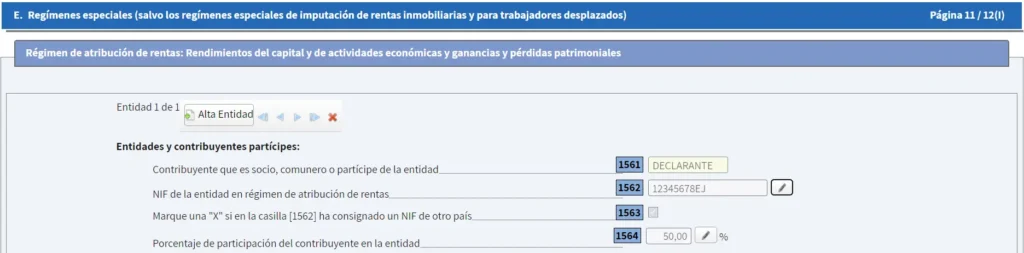
Entities in the income attribution regime (RAR) don't pay taxes as an entity. Instead, their income is distributed to their members, who report it on their individual tax returns. 📋
This also applies to some foreign entities, like U.S. Single Member Disregarded LLCs operating in Spain and taxed equivalently. 🌐
The issue with Model 100 in LLCs
Is this legal? To put minds at ease, we went straight to the source. We asked the Spanish tax authority to confirm the tax regime and, while we had them, asked for explanations about the infamous 'bug'.
The error occurs when you're declaring these returns:
- The form asks for your participation percentage in the entity.
- But it only lets you enter up to 99%, even if you're the sole owner (100%).
- The form automatically calculates the income to report as:
Date: 07/02/2024
❓ The Citizen's Question
I'm a Spanish tax resident and sole owner (100%) of a disregarded U.S. LLC. When trying to file Model 100, the program only allows me to enter 99% participation. How should I report?
📢 Administration's Response (Literal)
Yes, it's Income Attribution:
Report in Model 100, Section E, as “economic activity income”.
On the Software Glitch (The Bug):
“The fact that the assistance program doesn't allow 100% entry in this particular case shouldn't undermine the previous obligation. What's relevant is including all income.”
📄 Official AEAT response dated 2024-07-02 — available on request through the AEAT Electronic Office.
🧮 Real Calculation Example (2026 Income Tax in Catalonia)
Assume your LLC generates $60,000 in revenue this year and has $15,000 in deductible expenses. This results in $45,000 in net profit, which, as a pass-through entity, is directly attributed to you as the sole member.
This means you must report that $45,000 in Spain, on your Income Tax Return, under the «Attribution of Income Regime» section. The LLC itself does not pay taxes in the U.S.; it only files informational reports using Form 5472 and a pro-forma 1120.
❌ Your LLC does NOT pay tax in the U.S.
Only files informational reports (Form 5472 + pro-forma 1120). No federal income tax if it has no effectively connected income (ECI) — US-source or effectively-connected income, and withholding, are taxed separately.
✅ YOU pay tax in Spain
Reports income on your Income Tax Return as «foreign economic activity income», applying current tax brackets.
🧾 IRPF 2026 Brackets Calculator
| Income Bracket | State | Regional | Total | Bracket Tax | Accumulated |
|---|
🔒 Club: Modelo 100 — the 99% participation box
How to reflect income attribution
The income-attribution regime (Modelo 100, Section E) requires declaring 100% of your LLC's profit as business income. When the AEAT program does not allow entering 100% in the participation box, the correct way to reflect the attribution must be determined by a Spanish tax advisor under current regulations and with supporting documentation — not a manual adjustment of the box.
If this gives you vertigo or your tax return is complex, don't risk it. We recommend using TaxDown (FULL Plan). They have their own software that sometimes allows adjustments the AEAT website doesn't.
📋 Documents you need to have ready:
If you're a Devil Club member with Manager service, you already have everything consolidated in your Corporate Evidence Dossier. This dossier includes:
- Complete bookkeeping: Income, expenses, and fiscal year balance.
- US tax returns: Form 1120 and Form 5472 filed with the IRS.
- Bank statements: Mercury, Wise, and other LLC accounts.
- Governance Ledger: Manager decisions and operations log.
- Invoices and contracts: Supporting documentation for deductible expenses.
If you don't have the Dossier, you'll need to gather each document separately (statements, accounting Excel, US tax returns, and invoices).
Plantilla Copy/Paste
📩 Text to send to TaxDown:
📩 Sample email to send to TaxDown:
Hi,
I have a US LLC as a single-member disregarded entity, and I'm a tax resident in Spain. I already have confirmation from the Spanish tax authority (DGT) that I can apply the income attribution regime in my personal tax return (IRPF).
I attach the Corporate Evidence Dossier prepared by my designated US Manager (Devil Club LLC), which includes:
• Complete bookkeeping for the year (income, expenses, balance).
• Filed US tax returns (Form 1120 + Form 5472).
• LLC bank statements.
• Governance Ledger.
• Supporting invoices and contracts.
I need your help with my personal tax return, including reporting the LLC's economic activity under the income attribution regime.
Let me know if you need anything else.
Thanks.
💸 Deductible expenses in an LLC: What you can and can't deduct
As we clarified earlier in the Myths section (Myth #1), if you have a US LLC (Limited Liability Company), you must include all business profits in your Spanish personal tax return (IRPF). This includes both amounts you withdraw and those you leave in the company. This way, you'll avoid issues with the tax authority and fulfill your tax obligations. 🇪🇸
Deductible expenses: Your only real tool
The key is to maximize deductible expenses. These are directly related to the business activity and are necessary and reasonable. By deducting them:
- 📉 You reduce the taxable base (the amount on which taxes are calculated)
- 💵 Pay less taxes
- 📈 You increase net profitability
If you're unsure what you can deduct and what you can't, you may make serious accounting mistakes that lead to penalties. That's why it's crucial to understand the rules on deductible expenses, a topic we'll cover in detail below. 🙌
Here's the catch. The IRS is flexible, but you are taxed in Spain (IRPF). Spanish rules apply.
*Note: In Spain, the burden of proof is on you. Keep your calendar, emails, and meeting records.
US Accounting: Keep it impeccable for your operations (Suppliers, SaaS, Banks).
Spanish Declaration: Filter and eliminate "flexible" IRS expenses that the tax authority won't accept.
Expectation: Your taxable base in Spain is usually higher than your real accounting profit in the U.S.
LLC deductible expense list
We created this Interactive Tool so you can stop guessing. Use filters to separate what's safe from what could get you audited.
Don't use your LLC as a personal piggy bank. Use this Expense Semaphore to filter your purchases.
Go ahead, without fear.
With care and perfect receipts.
Investments (amortized, not deducted at once).
🚦 Deductible Expense Semaphore
What the Spanish tax authority accepts and what it doesn't — IRPF Spain criteria
💸 How to bring money to Spain
Forget about “administrator payrolls”, IRPF withholdings on each invoice, and the hassle of Spanish LLC dividends. In a Single-Member LLC, company money is yours. The barrier is legal (liability), not financial.
🏛 In a Spanish S.L.
- You need payroll and social security.
- If you distribute profits (dividends), you pay taxes first at the company level (25%) and then personally (19-26%).
- Mandatory monthly/quarterly bureaucracy.
🦅 In your LLC (Owner’s Draw)
- At will: You transfer what you want, when you want.
- No withholding: The money travels "gross" to your personal account. You're responsible for setting aside for annual income tax.
- 0 paperwork: No need to declare anything upfront. Just make a bank transfer.
3-Click Operations
🔒 Digital Footprint Minimization
In the Big Data era, every transaction generates metadata. To regain your privacy, the strategy is based on identity decoupling: preventing a single provider from having a complete picture of your digital life.
🅰️ Global Platforms: Using international fintech gateways outside the CRS creates "information silos". Your operational expenses don't mix with personal ones, preventing cross-profiling.
🅱️ Identity Management: Operating with multi-currency accounts reduces the metadata your local bank collects on your subscriptions or international purchases.
🛡️ Digital Hygiene in Physical Space:
Location Privacy: Cash has no GPS. Prevent ad-networks from tracking your physical movements.
Limits: Corporate cards have ATM limits. Plan your liquidity ahead of time.
BEWARE! Many activate the "Savings Account" in Mercury, Wise, or American banks to earn interest. FATAL ERROR.
Although the U.S. is not in the CRS, it does sign FATCA/IGA agreements. If your account generates benefits (interest), the bank is obligated to report that income to the IRS. And the IRS can exchange that information with your country's tax authority.
🇪🇺 European VAT and U.S. LLC: MoR, OSS, and how to manage it
Navigating European VAT with a U.S. LLC can feel like a bureaucratic maze. With 27 countries, each with its own rules, it's complex.
VAT · DECISION
Determine place of supply first
Customer, supply, human intervention and merchant of record can change the outcome.
BUSINESS · B2B
CONSUMER · B2C
*Conditions: no PE in Europe, services actually delivered from outside the EU, dominant human factor, and effective use by the client outside Spain.
The goal of this section is to give you a clear and direct roadmap. 🗺️
Before we dive into the comparison table, it's crucial you know about a game-changing 'shortcut': Merchant of Record (MoR).
Imagine a bulletproof shield. Instead of selling directly to the end customer, you sell to an intelligent intermediary (Hotmart, Paddle, Lemon Squeezy). They're the legal seller.
How it saves you:
- ✅ Automated Calculation: They know if the customer is from France (20%) or Hungary (27%).
- ✅ Total Management: They collect, report, and pay taxes to 27 European tax authorities.
- ✅ Your Peace of Mind: The 'messy' part is theirs. You receive a net transfer (minus their 5-10% fee).
*Ideal for B2C digital products where you want maximum simplicity.
Here's a side-by-side comparison of our turnkey strategy versus direct management, so you can choose the best approach for your business. 🚀
Strategic Tax Guide • Updated 2026 • Digital Taxation
Reverse Charge applies. VAT validation in VIES required.
Only if you provide the service from outside the EU (not nomads in Spain). Residence test required.
If you're physically in Spain, the Spanish tax authority considers you a Permanent Establishment. High tax risk.
VAT at destination. You need to use OSS or Stripe Tax to manage it.
They're the legal seller. You receive clean net. Low complexity.
Switch to VAT at destination (Directive 2022/542). Adaptation required.
For most cross-border service cases you sell to other businesses (B2B), where the reverse charge applies, the key reference is the article that states the recipient (your client) is responsible for paying VAT. Add the following phrase to your invoice.
⚖️ The Big Exception of 2025
The difference between paying 21% VAT or 0% isn't in the format, it's in the nature of the service.
❌ Hybrid Model (Standard)
What you sell: Access to recorded videos + weekly group Q&A.
The problem: The primary value is the automated content. Human intervention is "accessory". The tax authority classifies it as "Electronic Service" → Pay VAT at destination (where the client lives).
✅ Mentoring Model (Asynchronous)
What you sell: Support videos + Personal 1-on-1 review.
The key: The client pays for your analysis of THEIR work. The human factor is 80%. It's a "Professional Service/Consulting" → Taxed at source (U.S. = Not Subject).
🧠 Why does this exception work?
To make this legitimate and not a scam, you must comply with these requirements:
- No Permanent Establishment in Europe: The LLC should not have a habitual physical presence that could be considered a fixed place of business.
- Actual Provision from Outside: The work (editing, email, video) must be effectively done from outside the EU (e.g., Paraguay, Bali, the U.S.). If you work from your sofa in Madrid, the tax authority will catch you.
- Real Personalization: Don't just send 'copy-paste' responses. There must be genuine human intervention.
- B2C client outside Spain: The 0% is more solid with clients outside Spain. With a consumer resident in Spain, the effective-use rule (art. 70.Dos of the Spanish VAT Law) may trigger Spanish VAT even though you provide the service from outside.
🛡 ️ How to prepare for a VAT request
If it's the latter = NO VAT*
Since January 1, 2025, the EU allows all Member States to exempt freelancers and SMEs invoicing less than €85,000 per year from VAT. This is the so-called “VAT franchise”: you don't charge VAT, you don't declare it quarterly, you don't file an annual summary. In exchange, you also don't deduct VAT on your purchases.
The other 26 EU member states have already transposed it. Spain is the only country that hasn't. The tax authority argues that “the existing Spanish simplified regimes already serve that function” — an argument Brussels has not accepted. In March 2026, the European Commission took Spain to the EU Court of Justice for non-compliance.
✅ If Spain transposes (expected 2026-2027)
- Invoicing <85K → you wouldn't charge VAT to EU clients
- Less quarterly paperwork
- Your LLC remains unaffected (US entity, not subject to European VAT per se)
- But if you as an individual sell B2C digital products in the EU, you'd benefit
❌ While Spain doesn't transpose
- You still need to declare VAT on B2C digital sales in the EU
- Competitors in France, Germany, Portugal <85K don't charge VAT
- Real competitive disadvantage for Spanish entrepreneurs
- Another reason to operate through your LLC: in B2B, there's no VAT with reverse charge
🔎 Goal: Check this summary table to see the real risk to your LLC based on how you get paid. We analyze two scenarios: the classic Stripe, and the attempt to “hide” by collecting directly from the bank.
Debt: Accumulation of VAT with the EU and UK (approx. 21% of sales) + fines.
Operations: 💥 FUND BLOCKING — the tax authority can order Stripe to hold your future payments.
Debt: Accumulates all the same. The entity is 100% liable.
Operations: Mercury: Hard to seize (US bank). Wise/Revolut: Higher risk of account closure. They don't report under DAC7, but you're exposed.
🍀 The OSS Route: Direct Management
If you decide not to use an intermediary (MoR) and collect payments yourself, you have an obligation: Collect and pay VAT. Welcome to the One-Stop Shop (OSS) regime.
What is "Non-Union OSS"?
It's the EU's simplified system for foreign companies (like your LLC). Instead of registering in all 27 countries, you register in just one (the identification member state).
From that country, you file a single quarterly return and make one payment. They handle distributing the money to the rest.
📍 Where Do I Register? The Irish Strategy
- Language: All bureaucracy is in English (not German or French).
- Efficiency: Their portal (ROS – Revenue Online Service) works well and is adapted for US businesses.
- Natural Bridge: It's the standard entry point for American tech companies in Europe.
«Registering your LLC with Ireland's OSS gives you a VAT number (starting with EU) valid for sales across the Union.»
☠️ The Hidden Price: Goodbye Anonymity
Here's the fine print nobody reads. If you set up an Anonymous LLC in New Mexico to protect your privacy, OSS completely undermines it.
Your name will appear in European tax records.
European tax authorities share information.
Your New Mexico «privacy shield» doesn't apply here. You've voluntarily identified yourself by applying for a VAT number.
🇺🇸 IRS forms for foreign LLC: 5472, 1120, FBAR, and Sales Tax
Let's be clear: in the United States, a non-resident disregarded LLC generally pays no federal income tax if it has no effectively connected income (ECI) — but the reporting obligations are strict and failing them is costly.
U.S. · REPORTING
Four authorities, four triggers
Not every duty applies to everyone. Each depends on different facts.
While in Spain, the tax authority wants your money, the IRS is obsessed with your information. The deal is simple: they let you operate free of corporate taxes in exchange for absolute transparency about who you are and how much you move.
Many entrepreneurs fall into this trap. They think that since an LLC is "pass-through", there's nothing to file. Fatal error. The U.S. system is binary: either you report on time and in the correct format, or you're hit with automatic fines starting at $25,000.
Here's the map of mandatory bureaucracy so your LLC remains a vehicle for freedom, not an administrative nightmare.
In the U.S., a non-resident disregarded LLC generally pays no federal income tax (depending on the facts), but you're required to report — and failing to do so is costly.
Informational annual return for foreign owners. Reports transfers between your LLC and you.
Penalty: $25,000 / year
📅 Annually (April 15)
Required ONLY if your LLC has bank accounts outside the U.S. (e.g., Wise Belgium) holding more than $10k in total.
📅 Annually (April 15) · See service →
BEA statistical survey to declare foreign investment (or its exemption).
⏱️ First 45 days (after registration) · See service →
Beneficial Ownership report. Exempt under FinCEN's interim final rule (March 2025) for U.S. domestic reporting companies — including every Devil Club LLC. No filing required. We monitor for any later regulatory changes.
⏱️ Exempt under FinCEN interim final rule 2025
5472 + 1120 sounds intimidating, but with us it boils down to filling out an online form in 15-20 minutes. No PDFs, no Excel, no need to go anywhere. You provide the data, we handle the IRS filing.
What exactly do we ask you for?
👤 Personal data
- Name and address
- Country of residence
- Passport number
💰 This year's finances
- Distributions (what you withdrew)
- Contributions (what you put in)
- Balance as of December 31
🌐 Accounts and relationships
- Bank accounts (FBAR)
- Invoices between your own companies
- Countries of activity
🏛️ Legal Responsibilities (Maintenance)
If you've decided to open an LLC, you need to know that it's not enough to just create the company: you also have to keep it up to date with the legal and tax requirements of both countries.
Public Address: You must have a public U.S. address to receive business correspondence.
Registered Agent: Receives official notifications and certified mail on behalf of the LLC. Must have a physical address in the state.
Psst: we've simplified it — your LLC's legal address and the Registered Agent's are the same. One single address in New Mexico for everything. Fewer headaches for you.
LLC Documentation: Includes the Certificate of Formation, Operating Agreement, and EIN (Employer Identification Number).
ITIN (Individual Taxpayer ID Number): If your business requires it, you must apply for it.
When will they ask for it?
• PayPal Business: requests it during verification of your Business account linked to the LLC.
• Dividend investments: if you invest in ETFs or dividend-paying stocks from your LLC account, you'll need an ITIN to have the correct withholding applied (and then deduct them in your country with form W-8BEN).
• Double Taxation Agreement (DTA): to benefit from reduced tax rates under the tax treaty between the U.S. and your country.
Cost: ~$350 USD
Process: Managed by a CPA or authorized Certifying Acceptance Agent. Requires submitting original or certified documentation.
📚 Accounting: What You Need to Know
Many believe LLCs don't need accounting. This is a dangerous myth. Even though you don't have to file accounting books with the Registry (like a Sociedad Limitada), you must have clear records.
🏛️ California / NY / Utah
They require formal accounting, balance sheets, and income statements. Administrative nightmare.
🌵 New Mexico Your Case
No formal books are required. The minimum legal requirement is to track distributions and contributions. But be careful: you need this data to fill out Form 5472 and your Spanish tax return (IRPF).
🛒 Sales Tax in the U.S.: Not VAT, but It Bites
In the U.S., there is no federal VAT. Instead, each state applies its own Sales Tax with different rates and rules. Five states have no Sales Tax (Montana, Oregon, Delaware, New Hampshire, Alaska). The rest range from 2.9% (Colorado) to 7.25% (California), and counties can add their own local rate.
How does this affect your digital LLC? In theory, you only pay Sales Tax in a state if you have «nexus» there (physical presence, employees, or sales volume above a certain threshold). Since your LLC operates without physical presence, the issue isn't that you must charge Sales Tax to your customers, but that your suppliers may charge you for being registered in a state that applies it.
What does it mean? If you use an NM address, providers like Google, Facebook, or Amazon might try to charge you an extra % on their invoices by default.
The W-8BEN-E and the W-8/W-9 family of forms document, to whoever pays you, the status of the recipient of U.S.-source income for federal withholding / FATCA — a separate matter from sales tax.
Which one applies depends on your structure: a U.S. LLC is not, in itself, a foreign entity, and if it's disregarded the question shifts to its owner. Determine with an advisor which form fits you. What it is NOT for: none of these forms is a sales tax exemption certificate — that tax depends on the state, the nexus and whether the platform is a Merchant of Record (see below).
*Note: Always consult an advisor if you're unsure about «Economic Nexus» in specific states.
🗺️ Sales tax on digital services: how to handle it properly
The real problem: platforms like Google Ads, Facebook, AWS or Zoom calculate sales tax based on your LLC's billing address. If your state taxes digital services, you'll see that charge on the invoice.
The correct response is not to fake your location by entering an address in a state without sales tax so the platform recalculates to 0%: that means entering false, relevant data into the transaction (and can trigger address-verification — AVS — blocks and liability). If the tax doesn't apply to you, the right path is to determine that under the state's rules, not to hide where you are.
📄 The 1099 Form: What Is It and When Will You Need It?
The Form 1099 is the IRS mechanism for tracking payments between businesses. If your LLC pays someone more than $2,000 in a year (threshold in force for payments made from 2026; previously $600), you generally need to issue a 1099-NEC to report that payment to the IRS.
✅ When it APPLIES
- You pay a US contractor (individual or domestic LLC)
- The payment exceeds $2,000/year
- Some banks and processors require you to confirm if you've filed it
❌ When it DOES NOT apply
- You pay a foreign vendor (designer in Spain, developer in Latam)
- You pay a corporation (C-Corp or S-Corp)
- Payments for physical merchandise (not services)
📄 The 1099 Myth
The Panic: You think you need to report every payment you make to designers, programmers, or virtual assistants to the IRS.
The Reality: The IRS doesn't care about money going to non-US residents. They only care about income received by US taxpayers.
The Form 1099-NEC is a notification to the IRS that you've paid someone, and they should collect taxes from them. But if that person isn't a US resident, the IRS doesn't care. Here's the golden rule to save you unnecessary paperwork.
🎯 When Are You REQUIRED to File?
Only if both conditions are met simultaneously:
- 💰 Condition 1: You've paid more than $2,000 in a calendar year.
- 🇺🇸 Condition 2: The recipient is a US Person (Citizen, Tax Resident, or an LLC owned by a US resident).
🛡️ The Gray Zone: Hiring other LLCs
The Shield (W-8BEN)
If you hire a foreign freelancer or a non-resident LLC (Foreign Owned), it's best practice to have them sign a Form W-8BEN. This is just for your records; you don't send it to the IRS. It serves as proof: "I didn't issue a 1099 because they swore they're not U.S. persons."
The Practice (Saving Mode)
Let's be clear: If you pay a company in Spain or a contractor in Latam, the likelihood of an IRS audit for not having their W-8BEN on file is extremely low. If you know they're not U.S. persons, just don't file the 1099 and move on.
🇪🇸 Modelo 720
Foreign assets (>50K€)
🇺🇸 5472+1120 + FBAR
🇪🇸 Modelo 100 (IRPF)
The critical quarter
📋 Annual Report
Only if state requires (NM = none)
📊 Fiscal year-end
Prepare accounting + review 50K€
📅 Annual Compliance Calendar (USA + Spain)
⚠ Dates may vary. Always consult with your tax manager.
📋 Annual Reports: State "revolutionary tax"
Some states require you to file an annual report and pay a fee just for existing. It's pure paperwork, adding nothing to your business — but failing to do so results in administrative dissolution of your LLC.
| State | Annual Report | Annual Cost | Comment |
|---|---|---|---|
| New Mexico | Does not have | $0 | No additional paperwork. One more reason to choose it. |
| Wyoming | Yes | $60/yr minimum | Based on assets in WY. Minimum $60, increases with volume. |
| Delaware | Yes (Franchise Tax) | $300/yr | Annual fixed rate of $300. Expensive for a small LLC. |
| Florida | Yes | $138.75/yr | Popular but with moderate maintenance cost. |
| Texas | Yes (Franchise Tax Report) | $0 if < $2.47M | Exempt for small LLCs, but still requires filing. |
✓ Figures verified as of July 5, 2026 against official rates (state and providers).
🇪🇸 Modelo 720, IRPF, and Modelo 130: Obligations in Spain with your LLC
🇪🇸 To the Spanish Tax Authority: Pay and Report
In Spain, you have two mandatory appointments. One affects your wallet (IRPF) and the other your privacy (foreign assets).
This is your annual IRPF tax return. Here, you report your LLC's net profit to be taxed in Spain.
Income Attribution Regime (RAR)
100% of profit (whether you transferred it or not)
Adjustment formula for the 99% cap
Informative declaration about foreign assets. You don't pay anything, but the fine for not filing is severe.
🚨 The €50,000 Threshold
Only required if you exceed €50,000 in one block.
Accounts: If you're authorized (e.g., Mercury/Wise).
Assets: The total value of your LLC (shares).
👻 What If I Forget? From Terror to Procedure
Until recently, failing to file form 720 meant absolute disaster. Today, thanks to European regulations, the story has changed dramatically.
☠️ Before 2022 — The “Civil Death”
The Spanish tax authority would impose fines that sometimes exceeded the value of your assets. Moreover, there was no statute of limitations. They could come after you 20 years later.
- Minimum fine of €10,000.
- Penalty of 150% of the undeclared value.
⚖️ The Reality Today — Proportionate Penalties
European justice struck down the Spanish law as abusive. Now sanctions are normal and, most importantly, they prescribe after 4 years.
- The regime must be proportionate (no longer confiscatory like the old one).
- Regularizing spontaneously (before a request) is treated more favorably than doing it after being contacted.
Imagine you have an LLC and a Wise account. You forget to file form 720 in March and voluntarily file it in May (without the tax authority having notified you).
(Minimum under old law)
(Fixed administrative penalty)
Heads up: filing spontaneously (before a request) is treated more favorably than waiting for the tax authority to contact you. The specific amounts are set by the applicable penalty regime (LGT arts. 198/199) — confirm them with an advisor.
The obligation arises when you exceed €50,000 in any block (accounts, securities or real estate). Note: it isn't reduced to a single day's snapshot — the threshold calculation follows specific AEAT rules. Don't plan your obligation around the December 31 balance; confirm it with an advisor.
In a procedure, you strictly answer what's asked. Providing extra information on unsolicited assets (e.g., mentioning stocks when asked about accounts) is a procedural error that opens unnecessary doors. Surgical precision.
Assets aren't isolated if there's money flow. A personal transfer to your LLC creates a visible link. You must understand what's visible through automatic exchange (CRS) and what remains private to avoid inconsistencies in your statements.
Forgot the 720? Regularizing spontaneously, before the tax authority requests it, is treated more favorably under the penalty regime than doing it after being contacted. Do it as soon as possible and consult an advisor.
File the Modelo 720 on time. If you miss the date, filing it spontaneously (before any request) is treated more favorably. Document every figure and consult an advisor if you're unsure about categories or valuation.
Administrative infractions prescribe after 4 years — that's a legal limit on the authority's action, not a strategy to count on going undetected. Your obligation is still to declare correctly and on time.
💣 Red Line: The Modelo 184
The Modelo 184 is the annual informative declaration that entities use to tell the tax authority: "This is what we've earned and how it's distributed among partners."
To file it, an income-attribution LLC needs a Spanish tax ID (Letter N), which means registering the entity with the Spanish tax authority. Whether your LLC is required to file the Modelo 184 — and to obtain an NIF — depends on your specific case: number of members, activity, tax residency, and whether the entity is already registered in Spain.
🇵🇾 And in Paraguay? Modelo 184 is a requirement exclusive to Spanish tax residents. In Paraguay this informational return doesn't exist, nor does any equivalent. No Spanish NIF, no census, no need to “Spanish-ize” your structure. Paraguay's DNIT doesn't share data with the Spanish tax authority on U.S. LLCs. Explore residency change →
🗓️ Your LLC tax calendar: what you file and when
Every form has its own chapter in this guide; here they all are, together and in order. This is the typical year for a New Mexico SMLLC whose owner is a Spanish tax resident — filter by country and review it at a glance.
CALENDAR
Two jurisdictions, one control
Separate the U.S. from tax residence. Exact dates must come from the reviewed claim registry.

Two jurisdictions require one control system.
| Moment | United States | Tax residence |
|---|---|---|
| Formation and changes | EIN, state and BEA if applicable | Registration, classification and records |
| Monthly/quarterly | Books and sales tax if applicable | VAT, payroll or estimates if applicable |
| Annual | IRS, FinCEN and state based on facts | Income, wealth and information returns |
| Material change | People, agent, inventory or closure | Residence, activity, control or accounts |
🗓️ Your tax year on one timeline
-
45 days after formationBE-13 (BEA)One-time
New foreign direct investment survey from the Bureau of Economic Analysis. Filed once when the LLC is created; the BE-12 census runs every 5 years.
-
JanuaryModelo 184If applicable
Only multi-member LLCs under income attribution (with activity or income >€3,000). From January 1 to 31 of the following year.
-
By March 31Modelo 720If applicable
Spanish foreign-assets report: only if any block (accounts, securities, real estate) exceeded €50,000 on December 31.
-
April 15Form 5472 + pro forma 1120
Your LLC’s annual IRS filing. Extendable to October 15 with Form 7004. Not filing costs $25,000 per form.
-
April 15FBAR (FinCEN 114)If applicable
Only if the LLC held over $10,000 aggregated in non-US accounts during the year. Automatic extension to October 15.
-
April – June 30IRPF (Modelo 100)
Spanish income tax season: you declare the LLC’s profit under income attribution, whether distributed or not.
-
June 1Delaware Franchise TaxIf applicable
Only if your LLC is registered in Delaware: a flat $300 per year, due before June 1.
-
LLC anniversaryAnnual renewal
Registered Agent and maintenance. Wyoming files its Annual Report (~$60); New Mexico requires no annual report.
-
Every quarterEU VAT OSSIf applicable
Only if you sell B2C to EU consumers under the One-Stop Shop: quarterly return.
👷 Do I need to register as self-employed with an LLC? RETA and habituality
To determine if you're required to pay the fee, we need to analyze the nature of your activity, not the form of your company. Here's your roadmap:
Risk analysis on the obligation to pay self-employment taxes living in Spain according to your activity with the LLC.
If you do the work from your home in Spain, Social Security usually considers it self-employed work. The LLC is just a "layer", but your activity may be considered habitual and very personal.
The key is "habituality". If the business runs on its own and you only look at metrics, you can argue against habituality. If you code or manage daily, they may consider it professional activity.
If it's your primary source of income and you dedicate hours every day, they could prove "habituality". However, many courts consider it private asset management.
Safe zone: managing your own money is usually considered private asset management. Risk only appears if there is an active business structure.
Intellectual property income usually does not require RETA if there is no active business structure behind it. It's an asset that generates income without daily activity.
If you're preparing for a residency change and your activity in Spain is residual, the continuity requirement may weaken. A good time to reorganize structures before leaving.
📊 Realistic thresholds: How much risk do you have?
Jurisprudence and DGT (the Spanish tax authority) consultations establish that the key criterion is habituality (Art. 305.1 LGSS). In practice, these are the thresholds that mark the thermometer:
1. Natural persons over eighteen years of age who carry out, on a habitual, personal, direct, self-employed basis and outside the scope of management and organisation of another person, an economic or professional activity for profit — whether or not they employ workers — shall be compulsorily included within the scope of the Special Social Security Scheme for Self-Employed Workers (RETA), under the terms and conditions established in this Act and its implementing regulations.
Show original Spanish text (BOE)
1. Estarán obligatoriamente incluidas en el campo de aplicación del Régimen Especial de la Seguridad Social de los Trabajadores por Cuenta Propia o Autónomos las personas físicas mayores de dieciocho años que realicen de forma habitual, personal, directa, por cuenta propia y fuera del ámbito de dirección y organización de otra persona, una actividad económica o profesional a título lucrativo, den o no ocupación a trabajadores por cuenta ajena, en los términos y condiciones que se determinen en esta ley y en sus normas de aplicación y desarrollo.
< SMI/yr
~€15,876 · Income below minimum wage. Strong argument against habituality.
€15K – €30K
Depends on whether the activity is automated (SaaS, courses) or you provide the service directly.
> €30K
You provide the service + high income = near-certain habituality. Register as self-employed.
Annual LLC income < SMI (~€15,876/yr in 2026)
Strong argument: income below the SMI suggests there's no habitual economic activity.
Income €15,876 - €30,000/yr + automated activity (SaaS, courses)
Gray zone. Depends on whether you can prove there's no habitual personal activity from Spain.
Income > €30,000/yr + you provide the service directly
High risk. Social Security can easily establish habituality.
*Approximate percentages based on case law and binding consultations. Not a substitute for professional advice.*
📜 Binding consultations and relevant jurisprudence
- Consulta V0832-23 (DGT): Confirms that an LLC is classified as an entity under income attribution regime. Profits pass to the owner's IRPF. Not directly subject to RETA obligation, but clarifies that the structure doesn't shield against Social Security.
- STS 5504/2017 (Supreme Court): This ruling does not set an automatic rule of 'if you work every day = self-employed'. The Supreme Court rejects the SMI criterion as the sole reference and establishes that habituality is determined by looking at the set of circumstances: continuity over time, organization of resources, and direct personal dedication.
- TGSS Criterion: The General Treasury has been using the SMI as an informal reference threshold. If your income exceeds the SMI, the presumption of habituality is reinforced — but it's not automatic.
Stop looking for the magic rule of “how much can I earn without registering?”. That's thinking in tax shortcuts. Social Security and the courts look at 4 things:
- Is there an intention to engage in economic activity?
- Is there continuity or repetition over time?
- Are you organizing resources (clients, marketing, tools, structure)?
- Is your personal work key to generating income?
If the answer to all four is yes, you're in the red zone even if you invoice little. The myth that “as long as I don't reach the SMI, I don't have to be self-employed” is false as a general rule — STS 5504/2017 goes precisely against that shortcut.
The right question isn't “am I self-employed?” but “am I operating as a real economic activity?”. If the answer is yes, the discussion is how to structure it so you don't expose yourself.
⚠️ Watch out for personal branding: If you're the public face of your business, post from Spain, record videos, do livestreams, and your clients associate you personally — the LLC is not a shield against RETA. The key isn't only invoicing little, it's not looking like the employee of your own company from a Spanish IP.
Modelo 130 is the quarterly "bite" from the Spanish tax authority. It’s the mechanism for advancing IRPF if you’re a self-employed worker.
Quarterly: Apr, Jul, Oct, Jan
Lending money to the State in advance
Recurring paperwork that ties you to an accountant
Do you need to file it or are you exempt? The dilemma of whether you’re really "self-employed" is a crucial question.
Contingency planning for your retirement
An LLC gives you business efficiency, but it removes the state’s safety net if you don’t pay RETA. If you’ve optimized your IRPF, it’s your responsibility to plan your retirement, health, and wealth privately. Don’t rely on others!
✈️ Changing Fiscal Residency and LLC: CFC Rules and Global Options
Establishing an international presence with your LLC requires understanding the implications of your fiscal residency and how each country's regulations affect your business structure.
☠️ The Trap: CFC Rules (International Tax Transparency)
What Spain considers a transparent entity (pass-through), other countries may view as opaque and subject to CFC rules. CFC Rules aim to prevent you from setting up a foreign company solely to defer or avoid taxes when you control it and it lacks a real structure.
🧳 Checklist: Jurisdiction Analysis (What to Consider with an LLC)
Your fiscal residency choice directly impacts your LLC management and tax obligations. Each country has its own regulatory and tax frameworks that you must evaluate based on your personal and business objectives and how they align with your international structure. 🌍
It's crucial to conduct an individualized analysis to:
- 🔎 Classify your LLC in the new country (transparent, opaque, hybrid) and understand its effects.
- 🧠 Evaluate CFC rules and how they might impute undistributed profits to you.
- 💼 Determine the taxation of LLC income (distributed or not) under local regulations.
- 🏷️ LLC treatment: pass-through, corporation subject to income tax, hybrid entity?
- 🏢 Permanent establishment / significant presence: offices, employees, dependent agents, or effective management.
- 🧩 CFC rules: participation/control thresholds, low-taxation test, substance requirements.
- 📜 Tax treaties and withholding: treaty existence, withholding rates at source (royalties, interest, services) and credit mechanism in the destination country.
- 📅 Personal tax residence: days of stay, center of vital interests, habitual residence, effects of a change of residence.
- 🏦 Reporting and compliance: information models, CRS/FATCA, banking requirements (KYC/AML) and supporting documentation.
- 💳 VAT: B2B/B2C rules, OSS (or MoR if applicable), and local sales nexus.
- 🩺 Social Security: mandatory contributions, bilateral agreements, and coverage (healthcare, pension).
- 💸 Effective Taxation: marginal rates, exemptions/deductions, income allocation, and treatment of dividends/capital gains.
For strategic planning, a detailed analysis is essential. First, define where you reside (and will reside), and align your LLC's operations with that framework to avoid surprises.
See module Tax Residency Guide for LLC entrepreneurs and Tax Atlas of 44 countries for a full analysis.
🔒 Where It All Falls Apart: Failure Points of a "Perfect" LLC
🚨 The 5 Breaking Points
🚦 Risk Semaphore by Behavior
- You don't sign anything personally
- Manager handles visible operations
- Up-to-date compliance
- LLC account = business expenses only
- Passive/automated income
- You sign some minor documents
- You provide services directly
- Some personal expenses mixed in
- You don't document distributions
- Income 15K-30K€
- You sign, decide, and execute everything
- Habitual asset commingling
- You don't declare income in your country
- You don't have a Manager
- You post «I'm the CEO of my LLC» on LinkedIn
🌍 LLC by country: Tax residency compatibility
This guide focuses on Spanish tax residents, but LLCs work differently depending on where you live. Here's a quick compatibility map:
| Country | LLC transparent? | CFC Rules | IRPF on LLC profit | Compatibility |
|---|---|---|---|---|
| 🇪🇸 Spain | Yes (RAR) | Yes (Art. 91 LIRPF) | 19-47% progressive | 🟡 Workable with structure |
| 🇵🇾 Paraguay | N/A (territorial) | No | 0% (foreign income exempt) | 🟢 Optimal |
| 🇦🇩 Andorra | Depends | Limited | Max. 10% | 🟢 Very good |
| 🇵🇹 Portugal | Yes (similar to ES) | Yes | NHR: possible partial exemption | 🟡 Depends on regime |
| 🇵🇦 Panama | N/A (territorial) | No | 0% (foreign income exempt) | 🟢 Optimal |
| 🇦🇪 UAE (Dubai) | N/A | No | 0% personal IRPF | 🟢 Optimal (high cost of living) |
| 🇲🇽 Mexico | Yes (possible) | Yes (REFIPRES) | Up to 35% | 🔴 Complex |
| 🇦🇷 Argentina | Opaque | Yes (aggressive) | Up to 35% + personal assets | 🔴 Difficult |
| 🇨🇴 Colombia | Depends | Yes (ECE) | Up to 39% | 🟡 Workable with advisory |
| 🇺🇾 Uruguay | N/A (territorial) | No (foreign income exempt) | 0% on foreign income | 🟢 Very good |
⚙️ Daily Operations: EIN, Banking, and LLC Accounting
🗓️ How to get your LLC's EIN and open a US bank account
To operate your LLC, the first step is to obtain an EIN (Employer Identification Number). It's your LLC's US tax identification number and an indispensable requirement to open any bank account. When you get there, compare Wise vs Mercury vs Relay before choosing.
🗓️ When to apply for an EIN from the IRS?
Wait times are crucial and depend on IRS workload. The real range is 4 to 8 weeks: these three windows rank the wait from shortest to longest depending on the month you apply (via Fax/Mail):
Best window: April to July.
Reasonable wait: March to November.
Worst time: January and December.
CP 575, the expected letter with your EIN
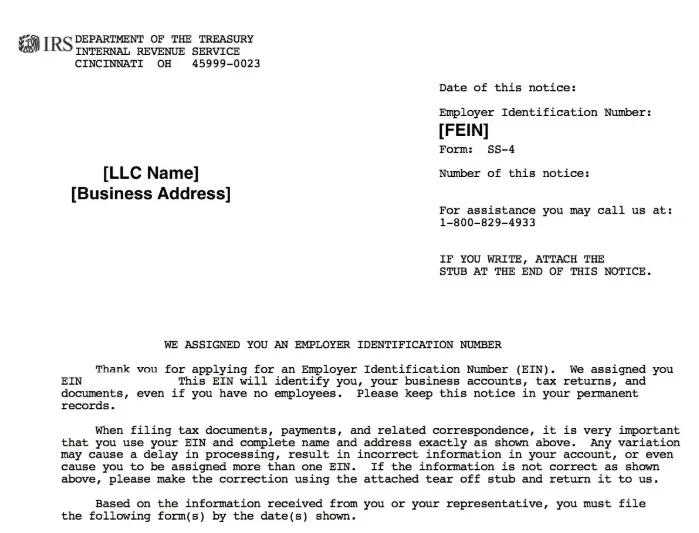
Open the LLC before the bank account?
📄 Proof of Existence (Key Documents)
The LLC's Tax Identification Number, equivalent to NIF/CIF in Spain. Without this, no neobank will open the door.
Document certifying the LLC's legal creation, containing basic company data. It's the birth certificate.
The form we submit to the IRS to request an EIN. These documents prove your business's legal existence.
🏦 Best bank for LLC in USA: Mercury vs. Wise
The 2 Giants for LLCs
BANKING · FIT
Compare by use, not by logo
Availability, KYC, account jurisdiction and operating risk vary.

The right account depends on use, flow and contingency.
| Criterion | B2B services | Ecommerce | Investment |
|---|---|---|---|
| Receipts | ACH / wire | PSP / marketplace | Transfers / custody |
| Currencies | FX cost | Settlement | Markets and withdrawals |
| Cards | Team and expenses | Ads and logistics | Limited use |
| Reserves | Contracts | Chargebacks | Source of funds |
| Contingency | Secondary account | Second rail | Separate custody |
U.S. neobank in dollars ($).
- 🇺🇸 US Focus: Invoicing, accounting tools, and integrations (Stripe/Shopify).
- 💳 Physical and virtual debit card.
- 🔗 Access to financing (if you meet requirements).
Specialist in transfers and currencies.
- 🌎 Multi-Currency: Operates in over 50 currencies, including € and $.
- ✅ Transparent Rates: Real exchange rates and low fees for international payments.
- 📬 You can receive payments with bank details from 10 different countries.
Neobanks comply with the same regulations and guarantees as traditional banks. By operating online and without physical branches, they cut costs and offer you better terms and services.
📊 LLC Bank Comparison Table
| Bank | Type | Currency | Cost | Card | Crypto | CRS |
|---|---|---|---|---|---|---|
| 🏦 Corporate Banking (your LLC account) | ||||||
| Mercury 🇺🇸 | Corporate | USD | $0/mo | ✅ Physical + Virtual | ✅ Friendly | ❌ Outside |
| Relay 🇺🇸 | Corporate | USD | $0/mo | ✅ Physical + Virtual | ⚠ Limited | ❌ Outside |
| Meru Business 🇺🇸 | Corporate | USD | $0/mo | ✅ Virtual | ❌ | ❌ Outside |
| Wise Business 🌐 | Corporate | Multi (50+) | $0/mo (one-time ~$31 setup) | ✅ Physical + Virtual | ❌ No | ✅ Inside (EU) |
| 🛡 Corporate Plan B | ||||||
| HighBeam 🇺🇸 | Corporate | USD | $0/mo | ✅ Unlimited virtual | ❌ | ❌ Outside |
| 👤 Personal Banking (for your distributions) | ||||||
| Payoneer 🌍 | Personal | Multi | $0/mo | ✅ Virtual + Prepaid | ❌ | ❌ Outside* |
| Meru 🇺🇸 | Personal | USD | $0/mo | ✅ Virtual | ❌ | ❌ Outside |
| Wise Personal 🌐 | Personal | Multi | $0/mo | ✅ Physical | ❌ | ✅ Inside (EU) |
| Revolut Personal 💳 | Personal | Multi | $0/mo | ✅ Physical + Virtual | ❌ | ✅ Inside (EU) |
✓ Figures verified as of July 5, 2026 against official rates (state and providers).
*Payoneer operates from the U.S./Israel. Verify your account's CRS status based on the issuing jurisdiction. — CRS = Automatic information exchange with the Spanish tax authority. ❌ Outside = the tax authority does NOT see your balance automatically.
🔎 Filter the banks by what you need
The same table from above, now interactive. Filters stack: combine several to see only the banks that fit your case.
-
Mercury 🇺🇸Corporate
-
Relay 🇺🇸Corporate
-
Meru Business 🇺🇸Corporate
-
Wise Business 🌐Corporate
-
HighBeam 🇺🇸Corporate · Plan B
-
Payoneer 🌍Personal
-
Meru 🇺🇸Personal
-
Wise Personal 🌐Personal
-
Revolut Personal 💳Personal
💵 Personal Banking: How to distribute funds without breaching the corporate veil
One of the most common mistakes is using your Mercury or Wise Business card to pay for personal expenses like dinner, groceries, or Netflix. This breaks the corporate veil. Mixing personal and LLC expenses can lead a judge to pierce the veil and consider you and your LLC the same entity — which would cost you limited liability protection.
The solution is simple: you make a distribution (owner's draw) from your LLC account to your personal account, and then pay from there. The distribution is recorded as such in your accounting and is perfectly legal.
U.S. fintech for non-residents. USD account, virtual card, ideal for spending in dollars without touching your European bank. Outside CRS.
Alternatives to review for receiving and spending distributions in USD. Before opening, verify country availability, KYC, fees, card access and account jurisdiction; do not treat them as guaranteed approval or guaranteed CRS treatment.
Multicurrency personal bank to evaluate if CRS is acceptable. It can be useful as a formal account, but do not use it as an outside-CRS alternative: verify country availability, KYC, costs and card access before moving distributions.
Multi-currency personal account. Receive USD from Mercury, spend with prepaid card in any country. Operates from U.S./Israel — not part of the European automatic CRS exchange (which does not change your reporting obligations wherever you are a tax resident).
Multi-currency personal account with physical card. Cheap currency exchange. Heads up: inside European CRS — the Spanish tax authority sees your balance. Don't hold Wise Personal and Wise Business at the same time: Wise allows both profiles under the same login, but we have seen it end in blocked accounts for several clients. If Wise is your LLC's bank, receive distributions with another provider.
Multi-currency personal account with card. Useful for spending distributions in euros. Inside European CRS.
📈 Investing with your LLC: Don't let your money sit idle
Your LLC isn't just for invoicing. It can also be your investment vehicle. With your EIN and LLC documents, you can open an account at:
The most complete broker for LLCs. Stocks, ETFs, bonds, options. Business account with the EIN. Minimal fees. Diversify in USD without moving the money out of the U.S.
Open a business account on U.S. exchanges with your LLC. Important: pick one that's crypto-friendly, accepts LLCs from foreigners, and holds a FinCEN license. See the 🔒 Crypto-Shield section.
Platforms like Fundrise, RealtyMogul or CrowdStreet let you invest in U.S. real estate with your LLC. Real diversification in U.S. physical assets.
📋 KYC: What U.S. banks will ask you (and why)
U.S. banks are cautious with foreigners. And rightly so: if a foreigner defaults, it's extremely difficult to pursue them legally outside the U.S. That's why the KYC (Know Your Customer) process is rigorous. Here's what they'll ask for:
Helpful bonus: Have active social media (LinkedIn, Instagram) for the business or personal. Bank compliance officers check them. A real, professional profile gives you bonus points over a «ghost» application.
🚨 What if your account gets closed or frozen?
It's not the end of the world. American banks close accounts for compliance reasons more often than you think. The most common reasons:
- 🥇 TOP 1: Operating crypto on a non-crypto-friendly bank. Wise, for example, is NOT crypto-friendly. If you receive funds from an exchange directly into Wise, they'll freeze the account. Mercury does accept crypto flows if you declare the activity.
- Mixing personal and corporate funds — Using your LLC account for personal expenses triggers alerts.
- Unusual activity spikes — If your LLC usually invoices $2,000/month and suddenly gets $50,000, expect a review.
- Sanctioned countries — Transactions with Iran, Cuba, North Korea, etc. = immediate closure.
- Prolonged inactivity — An account with no activity for 12+ months may be closed.
If a bank closes your account, they'll send a check with your balance to your registered address — which is your Registered Agent's address in the U.S. From there, your agent sends it to you and you deposit it into your new bank to collect. Meanwhile, you open an account with another neobank (Relay, for example, if Mercury closed your account, or vice versa). Your LLC remains active. The closure of one bank doesn't affect your company, just the payment channel.
💡 Devil tip: Always keep a backup bank. Mercury + Relay or Mercury + Meru Business is a solid combo. If one falls, the other keeps running.
🗺 DAC Map: Who Reports What to the Spanish Tax Authority
DAC directives (Directive on Administrative Cooperation) are the EU's tools for European countries to automatically share tax information. Each new version closes another loophole. Here's a summary:
| Directive | What is reported | Who reports | Since when | Does it affect you? |
|---|---|---|---|---|
| DAC2 | Bank accounts, balances, interest | EU banks and fintechs (Wise, Revolut, N26) | 2016 | Yes — If you have a Wise EU account with your LLC |
| DAC7 | Income on digital platforms | Marketplaces (Amazon, Airbnb, Etsy, Fiverr) | 2023 | Partially — If you use EU platforms as a seller |
| DAC8 | Cryptocurrencies + e-money (electronic money) | EU exchanges + e-money providers | 2026+ | Yes — If you operate crypto from EU exchanges |
🚨 Legal Alert 2026: The End of DAC8 Limbo
With the entry into force of Directive DAC8 in the European Union, the veil of invisibility over certain assets has fallen. The goal is to reinforce the automatic exchange of information (CRS).
Anonymity on Europe-based centralized exchanges is over.
You'll no longer be able to hold electronic money in € on European platforms without CRS reporting your LLC to the Spanish tax authority.
How to react to DAC8 and shield your LLC? We analyze it in 🔒 Club: Privacy and Anonymity in the Post-DAC8 era.
🔒 Privacy and Anonymity in the Post-DAC8 Era
💶 DAC8, CRS and FATCA: what is reporting and what is your obligation
DAC8 (crypto-asset service providers), CRS/DAC2 (financial accounts by institution, jurisdiction and residence) and FATCA are frameworks for automatic exchange of information between tax administrations. Currency alone does not determine your reporting obligation, and moving funds between currencies or jurisdictions does not remove the taxpayer's obligations.
Choosing which currency you settle in is a legitimate operational decision: with Stripe/Shopify you can set the base currency to USD (Stripe charges the client in € and settles in USD to your LLC), and a Merchant of Record (Hotmart/MoR) handles collection and sends you USD as net royalties. But that choice does not change what you have to report nor replace any reporting obligation.
💸 Hidden LLC Costs: What Nobody Tells You
The LLC setup price is transparent. What nobody mentions are the recurring costs and fees that eat into your profit without you realizing:
| Item | Real cost | Frequency | 💡 How to Minimize It |
|---|---|---|---|
| 💱 Currency conversion (the silent thief) | |||
| Mercury (USD→EUR) | 1% on non-USD wires (3% if paying by card in a foreign currency) | Each withdrawal | Don't use Mercury to convert. Send USD to Wise. |
| Wise (USD→EUR) | ~0.4-0.6% real fee | Each withdrawal | ✅ Best option. Real exchange rate + minimal fee. |
| Meru/Payoneer | 1-2% (Meru) / 1.2-4% (Payoneer, bank withdrawal, varies by corridor) | Each withdrawal | Pricier than Wise. Avoid for large conversions. |
| 📅 Annual maintenance | |||
| Registered Agent | $50-150/yr | Annual | Included with Devil Club. If you do it yourself, $100-150. |
| Tax Filing (5472+1120) | $250-500 | Annual (April) | Included with Devil Club. |
| State Annual Report (NM: not applicable) | Not applicable | — | New Mexico does not require an annual report for LLCs. |
| 📊 Spanish Tax Filings | |||
| Tax advisor (IRPF+720) | $300-600/yr | Annual | You need an advisor who understands LLCs. We show you how — it's simpler than it seems. |
✓ Figures verified as of July 5, 2026 against official rates (state and providers).
If you invoice $50,000 per year and convert with a traditional bank (~3% spread), you lose ~$1,500 in conversion fees you never see (Mercury's direct wire, at 1%, would already be $500).
With the Devil circuit (Mercury → Wise → your bank), that fee drops to ~0.5%: $250. The difference vs. the bank — ~$1,250 — stays in your pocket.
Result: with FX optimization alone, the Manager Plan ($2,400) pays back almost immediately. It's not an expense — it's an investment with ROI from year one.
📊 LLC Accounting: Is It Mandatory? What You Need to Keep
Many think LLCs don't need formal accounting. It depends. For New Mexico, it's not mandatory, but you must be able to show your profits to both the IRS and the Spanish tax authority. The good news: it's much simpler than it seems.
📋 Simple Bookkeeping: What you actually need (P&L)
No need for Quickbooks, American accountants, or complex software. For a digital services LLC, what satisfies both the AEAT and IRS is being able to show your profits with these 4 documents:
Who requires accounting from you in the U.S.?
Your LLC must report data (income, expenses, net profit) to:
- IRS (Internal Revenue Service) — Via forms 5472 + 1120
- FinCEN (Financial Crimes Enforcement Network) — Via FBAR if you have >$10K in non-US banks
- BEA (Bureau of Economic Analysis) — Via BE-13 within 45 days of forming the LLC (one-time; the BE-12 census is every 5 years)
Heads up: Some states like California or New York DO require full accounting with an auditor. But not in New Mexico or Wyoming.*
🧾 Invoicing: How to issue invoices with your LLC
Invoicing with your LLC is easy. There is no required format in the U.S. (unlike Spain's SII). You can invoice however you like: PDF, Word, online tool, or even an email with the details. Just make sure to include the basics:
1234 Main St, Albuquerque, NM 87102, USA
EIN: XX-XXXXXXX (optional)
Date: March 15, 2026
Due: Upon receipt
Bill To: Sample Client S.L. — Madrid, Spain
Payment: Wire transfer to Mercury Bank — Routing: XXXXX — Account: XXXXX
Important invoicing notes:
- EIN is optional on the invoice. You're not required to include it, but some corporate clients may request it.
- You can invoice in USD or EUR. If you invoice a European client in EUR, for accounting purposes you convert it: either at the exchange rate on the invoice date or with an annual average (simpler).
- No VAT. Your U.S. LLC doesn't charge VAT. VAT (if applicable) is the client's responsibility in their country (reverse charge in B2B).
- Tools: Mercury has integrated invoicing. You can also use Invoice Ninja (free), Wave, or just a Google Docs.
The biggest risk is irregular activity. If your bank (Mercury, Wise, etc.) detects fraud patterns (attempts at money laundering or commingling funds), they'll shut down your account before the tax authority (IRS/Spanish/your country) knows.
Best practice: Distribute the money to your personal/Meru account and spend it from there. Don't use the LLC account for daily consumption.
Ledger isn't an accounting program. It's your LLC's “black box”: just like an airplane's black box records every move the pilot makes, the Governance Ledger documents every decision requiring Manager authorization — with date, digital signature, and verifiable Transaction ID. If there's an audit (the “accident”), the Ledger is what proves management happened from the U.S. and was legal.
7 request types, each with its own review level:
- Profit distribution — you withdraw money from the LLC
- Capital contribution — you inject money
- Operating expense (OPEX) — software, services
- Strategic investment — assets, investments
- Intercompany transfer — between entities
- Sign collaborator contract — with PDF attachment
- Strategic decision — no money involved
Higher amount → higher review level
Governance isn't sexy, but it's your black box. When the Spanish tax authority asks “who decides in your LLC?”, you don't show them a WhatsApp — you show a governance log with signed resolutions and verifiable Transaction IDs. That's real substance. Exclusive to Devil Club members.
🔒 Club: Simple LLC Ledger
😈 Club: The Minimalist Bookkeeping Sheet (The Big Gift)
You know that accounting isn't mandatory for your New Mexico LLC, but it's the foundation for a stress-free April tax filing.
Ditch Quickbooks and other complex solutions that steal your time. If your LLC only offers digital services, you only need to track four key movements to stay on top of things. Less is more!
- No Software: Cloud-based (Google Sheets). Access from your phone or PC, no licenses required.
- 4x4 Accounting: Just fill in 4 columns to get 99% of the work done.
- Clean Data: Get your Net Profit and Distributions ready for Form 5472 and your IRPF.
*The link will automatically prompt you to make a copy to your Google Drive (no permissions needed, it's yours).*
🎬 A typical day with your LLC: Real-life simulation
What's a typical day like for someone with a Devil Club LLC? No theory, no jargon. Real life:
REAL OPERATIONS
A defensible sequence
Value comes from the coherence of the full cycle, not from one isolated document.
- Proposal
- Contract
- Delivery
- Invoice
- Reconciliation
- Archive
🔒 Crypto-Shield Post-DAC8
🪙 Digital Assets: Legal Framework
Reality: The NFT transaction must be a genuine operation justified for business purposes. Market Value: Transactions between your LLC and you (the owner) must be at market prices. Expenses: Only losses or expenses directly related to the LLC's activity are deductible.
- Legitimate purchase: Acquisition of NFTs with a clear business purpose
- Fair pricing: Valuation at verifiable market price
- Documentation: Exhaustive record of all transactions
- Tax simulation: Manipulating prices or creating artificial losses
- Tax fraud: Evading tax payments through fictitious structures
- Active scrutiny: IRS and the tax authority review digital asset valuations
The crypto ecosystem is constantly changing. No permanent recommendation exists. What works today may fall under European regulation (MiCA) in 6 months or change its LLC acceptance policies.
Evaluation criteria (review every 6 months):
- Reporting (DAC8/CRS): Choose the exchange for security and regulation, not for opacity. DAC8 requires crypto-asset service providers to report regardless of their location; your obligation to report does not depend on which exchange you use.
- Accepts non-US LLCs: Confirm they allow Business accounts for Wyoming/Delaware/New Mexico LLCs with foreign owners
- Clear regulation: Prioritize exchanges with FinCEN (US) license or similar, to give your bank confidence
Generally not crypto-friendly for direct flows from exchanges. High risk of fund blocking or account closure.
More receptive to LLCs that declare crypto activity, but requires total transparency on fund origin.
The rule is simple: Be transparent and document everything. Maintain an exhaustive record and justification of all digital asset transactions.
- Transaction log: Date, amount, counterparty, commercial purpose of each transaction
- Market valuation: Evidence of the market price at the time of the transaction
- Business purpose: Clear justification of how the digital asset is linked to the LLC's activity
- Tax advice: Consultation with digital tax and accounting experts for both jurisdictions
*Consult digital tax experts to ensure compliance in both jurisdictions.
😈 LLC Opening Service: Pricing and Process
Your Turnkey LLC: Roadmap, Deliverables, and Flat Fee for Smooth Operations.
🗺 ️ How to open an LLC step by step: Complete roadmap
If you want to create an LLC (Limited Liability Company) in the U.S., we make it easy. We handle everything so you can have your company up and running quickly, without paperwork or complications. We work with New Mexico, one of the most advantageous states for LLCs.
*The EIN depends on the IRS — the bottleneck is bureaucratic, not on our side.
Legal Formation
Official state registration (NM). Drafting of Articles and Operating Agreement + BE-13 Claim for Exemption + Founder Statement.
2–3 daysObtaining an EIN (IRS)
EIN processing via Fax. Dependent on IRS timelines.
4–8 weeks*Bank Account Opening
With your EIN in hand, we apply to Mercury, Wise, or Relay for your USD/EUR accounts.
3–5 daysDelivery and Operations
We hand over the company keys, accounts, and access to the Club. Time to invoice.
✓ All set!⏱ Estimated Total Time: 4 to 8 weeks
In 4 to 8 weeks (depending on the IRS) your LLC will be ready to operate and you'll be able to enjoy benefits like:
- Limited liability protection
- Management flexibility
- Operational efficiency and access to global clients
Why New Mexico: It's one of the most popular states for LLCs thanks to its simple formation, low costs, and efficient administrative framework, making it easy to maintain your company and focus on growing your business.
📆 Realistic timeline: What to expect week by week
Theoretical timelines are one thing. Reality is another. Here's what actually happens when you start the process:
💵 How much does it cost to open a U.S. LLC: Prices with and without a Manager
Choose your setup. Do you want just the company or the full structure with governance and documented evidence?
🔒 Rate locked in for life for founding cohort members (closed Feb. 2026).
- Document Management: Certificate, Articles, and Operating Agreement ready from day one.
- EIN (Tax ID): We obtain your tax ID number from the IRS for you, end to end.
- Registered Agent + Business Address: Legal compliance and mail receipt.
- Annual Reporting: We file Forms 5472 + 1120 for you. Zero hassle.
- Neo-Bank Link: Fast onboarding with Mercury, Relay, or Wise.
- 1:1 Support: Personal access all year for operational questions.
- IRS Liaison: We respond to official requests on your behalf.
- Access to Devil Club: Strategies and community of operators.
- Referral program: $150 credit for each client you bring, $100 discount for the referred person.
🛡 60-day guarantee: If we don't register your LLC, 100% refund.
🔒 Rate locked in for life for founding cohort members (closed Feb. 2026).
Real operational management from New Mexico to reinforce substance and separate your activity from Spain.
- Management Contract: Formal agreement demonstrating external management.
- Custom Operating Agreement: Adapted to reflect external management.
Exclusive governance dashboard inside Devil Club. Every decision requiring Manager authorization is recorded: distributions, resolutions, and key operations of your LLC.
- Total Traceability: Each authorization documented with verifiable economic cryptographic hash.
- Defense against the Spanish tax authority: Show that your LLC's decisions are made by the Manager from the U.S., not you.
Programmatic access to all your LLC data: bookkeeping, ledger, documents, tax presence, and more. Integrate Devil Club with your own tools.
- REST Endpoints: Bookkeeping, ledger, documents, entity, profile, payments, and tax presence.
- Scoped keys: Granular permission control per API key. See documentation →
🛡 60-day guarantee: If we don't register your LLC, 100% refund.
Annual renewal at the same price to keep your structure up-to-date and compliant.
Businesses evolve, change, or end. That's life. At Devil Club we believe in total freedom: You join because you want to, and you leave whenever you want. No fine print or abusive lock-in contracts.
Dissolution and Closure Pack — $300 one-time payment
If you decide to end your adventure, we handle shutting things down legally so the IRS doesn't chase you down the road.
- State Dissolution: We notify New Mexico of closure on the date you choose.
- Final Tax Filing: We file the final tax return with the IRS. It's covered by your active maintenance (client) or the full $450 closure (non-client); it's not part of the basic state-closure pack.
«Thanks for your time and your trust. If your path changes, we'll take care of switching off the lights correctly.»
Plans include the standard annual return (Forms 5472 + 1120). For more complex situations, we offer the following add-on services:
| Standard Tax Filing | $600 | Annual IRS return — included in both plans |
| Complex Tax Filing | $1,200 | Complex activity, multiple income sources |
| FBAR (FinCEN 114) | $200 | Required if bank balances > $10,000 |
✓ Figures verified as of July 5, 2026 against official rates (state and providers).
💵 Calculator: what it really costs (Year 1 + Year 2, line by line)
Everything the fee includes, with its market price if you bought it separately — micro-services and unlimited consultations too. Move the hours slider: that is where DIY blows up. Devil Club prices are read live.
💵 What it really costs (Year 1 + Year 2)
| Item | Bought separately (market) | Basic Plan $1,800/yr | Devil Manager $2,400/yr |
|---|---|---|---|
| Year 1 · Formation | |||
| State registration + feesNew Mexico | ~$50 | ✓ Included | ✓ Included |
| EIN (SS-4 to the IRS)fax, follow-up and weeks of waiting | $200 – $300if you outsource it; “free” if you put in the hours | ✓ | ✓ |
| Reinforced Operating Agreementa template won’t survive a KYC or an inspection | $300 – $500lawyer; generic template $0 (and pray) | ✓ Custom | ✓ Custom |
| BE-13 Claim for Exemption (BEA) + full docsArticles, Statement of Organizer, SS-4 copy | $100 – $300preparer — if you know it exists; the penalty for not knowing is bigger | ✓ | ✓ |
| Every year · Maintenance | |||
| Registered Agent | $125 – $299/yrUS market reference | ✓ | ✓ |
| Tax Filing (5472 + 1120)preparer with PTIN | $200 – $500/yr | ✓ | ✓ |
| FBAR (FinCEN 114)if applicable | $100 – $200/yr | ✓ | ✓ |
| Compliance monitoringalerts and deadlines for FBAR / BEA / renewals | $199 – $399/yr | ✓ Reminders | ✓ Automatic + Lucy |
| 16 LLC tools + financial dashboardinvoices, contracts, W-8BEN, calculators, consolidated panel | Scattered subscriptionsone app for each thing | ✓ | ✓ |
| Questions and consultationsunlimited, 24/7 | $2,000 – $2,392/yrstandalone consulting at $250–299/h | ✓ Unlimited 24/7 | ✓ Unlimited 24/7 |
| Bookkeeping + invoicingaccounting synced with your bank, invoices from the panel | $2,200 – $4,300/yrsoftware $30-60/mo + bookkeeper $150-300/mo | ✓ Simpletransactions, KPIs, reclassification | ✓ Integrated with Lucybooks in the US, reports with tax narrative, feeds your Tax Filing |
| Lucy — your business AI (BI)Health Score, weekly insights, human-voiced reports | Doesn’t exist standalonea BI analyst + reporting like this isn’t sold by the hour | — | ✓ |
| Governance with teethBitcoin-anchored Ledger, contract signing, evidence dossier, 183-day tracker, annual review, API | $1,500 – $3,000/yrcorporate secretary / substance — without the cryptographic anchor | — | ✓ |
| The cost that never shows up on the invoice | |||
| Direct risk | $25,000 if you miss the 5472 · BE-13 and FBAR penalties | Covered | Covered |
| Indirect riskthe worst one | Misusing the LLC (mixing money, zero docs) = piercing your limited liability: you lose the entire shield | Mitigateddocs + support | Shieldeddocumented substance |
| Total 2 years (in cash) | $5,398 – $8,730 | $3,6002 years × $1,800/yr | $4,8002 years × $2,400/yr |
✓ Figures verified as of July 5, 2026 against official rates (state and providers).
📦 What you get when opening your LLC: EIN, Operating Agreement, and more
We don't just give you "papers". We provide the essential tools to operate, open bank accounts, and comply with the law from day 1.
EIN (Employer ID Number)
Your company's fiscal ID. Without this, you're nobody in the U.S.
Purpose: Essential for opening Mercury/Wise and activating Stripe.
Articles of Organization
Your LLC's official birth certificate, stamped by the State.
Purpose: Legal proof of existence to third parties, vendors, and authorities.
Operating Agreement
The internal instruction manual. Defines ownership and roles.
Purpose: Key for the bank (KYC) and to demonstrate «substance» to the Spanish tax authority.
SS-4 Form (Copy)
The original application submitted to the IRS with your registration data.
Purpose: Sometimes Amazon or banks ask for it to verify the address and the «Responsible Party».
Statement of Organizer
The bridge document. We hand legal control over to you.
Purpose: Demonstrates the ownership chain while keeping your name out of the initial public record.
BE-13 Claim for Exemption (BEA)
Mandatory foreign investment declaration when creating the company.
Purpose: Avoid fines for failing to file the statistical report to the U.S. government. See service →
Governance Ledger
Governance registry integrated into your Devil Club panel. Each operation requiring Manager authorization is documented with date, signature, and reference.
Purpose: Documentary proof of economic substance to the Spanish tax authority. Demonstrates your LLC is genuinely managed from the U.S.
Access to Devil Club
The community and advanced resources (Hacks, Strategies, and Support).
Purpose: So you're not alone. Access to DAC8 updates, IRPF strategies, and support.
🔍 Checklist: What to require from an LLC provider (and what to never accept)
Your LLC isn't a domain you contract and forget. It's an international legal structure involving two countries, two tax authorities, a foreign bank, and your personal assets. The provider you choose will be in the middle of all that. Choose wrong, and you'll find out too late.
Not all LLC formation services are equal. Most set up the paperwork and disappear. Here are minimum non-negotiables you should require:
- They sell you the LLC and disappear. No post-sales support, follow-up, or compliance.
- They don't have a PTIN. Without an IRS Preparer Tax Identification Number, the person signing your return isn't authorized.
- Generic tax filing. They charge you for Form 5472, but it's handled by software, not a professional who understands your case.
- No real Operating Agreement. They give you a generic template from the internet instead of a customized Operating Agreement tailored to your profile.
- Slow response times. If your provider takes 15 days to respond to an email, imagine during an inspection.
- Lack of substance. They don't offer a Manager or governance system. Just paperwork and goodbye.
- Complete legal documentation from day 1: Articles, customized Operating Agreement, BE-13 Claim for Exemption, Founder's Resolution.
- Professional tax filing with PTIN. The person signing your 5472+1120 with the IRS must be registered and authorized.
- Real Manager + governance system. It's not enough to just put a name in the Operating Agreement. There must be documented resolutions, decision records, and cumulative evidence.
- 1-on-1 support and immediate response. Not a chatbot or ticket #4582. A person who knows your case.
- Proactive compliance. They notify you of deadlines, regulatory changes, and obligations BEFORE they expire.
- Community and ongoing training. Because rules change and you need to stay up-to-date without becoming a lawyer.
Most providers just hand you an Operating Agreement and call it a day. A serious service goes further: it documents every business decision as a formal corporate resolution, with cryptographic stamping and an immutable record. Why does it matter? Because if the Spanish tax authority asks «who decides in your LLC?», you don't show them a WhatsApp — you show a governance record with verifiable Transaction IDs. That's real substance. That's what defends you.
⚔ ️ Opening an LLC on your own vs. with an agency: Honest comparison
The internet tells you it's "three clicks". The reality is navigating international tax without a compass isn't an adventure, it's negligence.
- DAC8 (Europe): Do you know how it affects your Wise accounts? The tax authority is already looking there.
- FBAR 114: If you have money outside the U.S. and don't notify FinCEN, the fine starts at $10k.
- BEA (BE-13 / BE-10): Direct foreign investment in the U.S. — mandatory informational report with fines for non-compliance. We handle it.
If you spend $2,000/month on advertising (Ads), handling sales tax the right way — nexus, Merchant of Record and the exemptions that actually apply to you — keeps platforms from charging you tax you don't owe.
Conclusion: doing it right from the start saves you leaks every month.
Never Go in Blind Again
You've seen what actually happens behind the curtain: changing rules, tricks no one tells you and money slipping away without you noticing.
With Devil Club you don't just set up your LLC: you master the game, reduce risks, and save thousands every year.
«The real edge isn't paying less. It's always playing with inside information.»
🏛 LLC + Sociedad Limitada (SL): Can they be combined?
Yes, it can be done. But it's not our niche and we rarely recommend it. The LLC + Spanish SL combination makes sense only when you have a business with two distinct legs: one digital/international (LLC) and one physical/local (SL).
✅ Valid example
Digital agency (LLC invoices international clients) + physical location in Spain (SL for store/office with employees).
❌ Invalid example
Use the LLC to "invoice" your own SL for fictional services and reduce the taxable base in Spain.
This combo requires personalized tax advice. If your case fits, we analyze it in the free consultation, but it isn't a standard Devil Club service.
™ Protect your brand: Intellectual property with LLC
Your LLC protects your personal assets, but who protects your brand? If you have a business name, logo, domain, or course with a specific name, you need to register your trademark. The LLC alone does not protect you from someone registering your trademark before you.
Cost: ~$250-350 USD per class (official fee) + $500-1,000 lawyer
Timeline: 8-12 months until approval
Protection: Entire U.S. Essential if you sell to the U.S. market.
Cost: ~€850 for the first class (official fee)
Timeline: 4-6 months if there's no opposition
Protection: All 27 EU countries with a single registration.
🛡 Insurance for your LLC: Do you need it?
The limited liability of your LLC protects your personal assets, but there are situations where business insurance adds an extra layer of protection:
- General Liability Insurance — Covers third-party claims (unsatisfied customers, damages). From ~$30/month for small digital businesses.
- Errors & Omissions (E&O) — If you're a consultant or freelancer and a client sues you for a "professional error". Recommended if you handle high-value projects.
- Cyber Liability — If you handle customer data (SaaS, e-commerce). Covers security breaches and leaks.
🚪 Closing your LLC: Complete dissolution process
Sometimes it's smart to know when to close. You change your tax residency and the structure no longer serves you. Your business pivots. Or you simply stop operating. Whatever the reason, closing an LLC is an orderly process — not complicated, but it must be done right.
DISSOLUTION
Closing is not abandonment
An orderly close ends obligations and retains the required evidence.

Closing well means ending obligations and keeping the required trail.
To close well, make the full trail coherent.
Authority, contracts, collections, accounts, final filings and records must tell the same story.
When does it make sense to close?
- You no longer operate — If you've gone over a year without invoicing and don't plan to again.
- Change of tax residency — You move to a country where another structure is more efficient.
- Change of business model — You now need a C-Corp, an LLC or a different structure.
- Costs > benefits — If you keep the LLC open just to pay the Registered Agent and Tax Filing fees without generating income.
🗓 Step-by-step closing process
We handle the state dissolution for $300 USD. If you have active maintenance, it already covers your Final Tax Filing; if you are not a client, the full closure with Final Tax Filing included is $450. You just need to close the bank account and report remaining benefits on your tax return. No headaches.
DISSOLUTION · STEPS
Orderly LLC closure
The exact sequence depends on the state and remaining obligations.
- Authorize closure
- Stop contracts
- Reconcile and collect
- Final filings
- Close accounts
- Retain records
Practical Cases: Your Profile, Your Structure
Theory is fine, but you want to see how this works in real life. Here are seven real profiles — with numbers, structures, and concrete outcomes. No fluff, no smoke. Find the one closest to your situation and see what changes when you stop improvising and start executing with structure.
*Names are fictional. Numbers are rough estimates based on real cases. Always check with your tax advisor.
| Profile | Before | After | Savings/yr | Plan |
|---|---|---|---|---|
| 💻 Carlos (Dev) | ~42% | ~30% | ~€8,000 | BUNKER |
| 📈 Ana (Trader) | ~23% | ~20% | Protection | BUNKER |
| 🛒 Pablo (FBA) | ~40% | ~27% | ~€10,000+ | BUNKER |
| 🎬 Laura (Creator) | ~40% | ~26% | ~€7,000 | BUNKER |
| 👔 Miguel (Consultant) | ~20% | ~10% | ~$12,000 | BASIC |
| 🇵🇾 Diego (PY Consultant) | ~10% | ~0-3% | ~$5,000 | BASIC |
| 🚀 Lucia (SaaS PY) | ~22% | ~5% | ~$14,000 | BUNKER |
Do you identify with any of these profiles? Your structure is just a call away.
I WANT MY LLC →❓ Frequently Asked Questions about U.S. LLCs
The questions everyone asks before taking the leap. Straight answers.
You can't have salaried employees in Spain hired directly by your LLC, as this would create a «Permanent Establishment» and require taxation as a Spanish company.
However, you can hire freelancers, as long as they don't work exclusively for you or use permanent physical facilities on your behalf.
Absolutely! You can even register your company without traveling, obtaining a visa, social security number (SSN), or individual taxpayer identification number (ITIN). U.S. regulations don't impose restrictions on company formation for citizens worldwide, except for some countries subject to trade sanctions.
If your LLC operates online without a physical presence in the U.S., has no employees or dependent agents, and none of its members reside or are U.S. citizens, it will be classified as Foreign Owned and not considered Engaged in Trade or Business in the US. Without ETBUS designation, it benefits from a territorial tax exemption. In short, if the LLC meets these requirements, it will be exempt from U.S. taxes. Otherwise, it won't qualify for an exemption and must obtain an ITIN and be taxed in both the U.S. and its country of tax residence.
The LLC is a versatile structure for digital entrepreneurs and non-resident businesses with a global client base. It offers benefits like limited liability protection, management flexibility, access to U.S. financial markets, and operational efficiency for your global expansion. It's essential to evaluate the compatibility of your activity with the structure to ensure regulatory compliance.
If your business has a physical presence or a Permanent Establishment in Spain (e.g., restaurant, physical location, salaried employees), an LLC alone is not sufficient. In these cases, the LLC can complement a local entity (like a Spanish SL) for the international or digital activity, ensuring compliance with tax regulations in both countries.
- During each tax filing in Spain, you'll need to report your LLC's information and its profits for that tax year in the «Attribution of income regime» section of your IRPF tax return.
Modelo 720 (Informative): The LLC must inform the Spanish tax authority about foreign assets and rights that belong to it, if their total value exceeds €50,000. This annual filing includes detailed information on bank accounts, securities, insurance, properties, and other relevant assets.
Related-party transaction information: If the LLC conducts transactions with related parties, it's necessary to maintain documentation supporting these operations and establishing their market value. In case of an inspection, you'll need to provide this information to the tax authority.
We'll handle the following IRS forms on your behalf annually:
Form 1120: This document reports your LLC's income and expenses to the IRS for the fiscal year.
Form 5472: This form provides the IRS with information about your business type and details to be reported on Form 1120.
Starting from the year you form your company, you'll need to file the BE-13 with the BEA at formation:
- BE-13: This form helps the Bureau of Economic Analysis track foreign investment by reporting money flowing in and out of the country through businesses.
Additionally, if you operate or plan to operate in the U.S., you may need other forms. Initially, if your activity is based in Europe, you might not need to worry about these:
Form W-7: Used to apply for an ITIN from the IRS, similar to an EIN, allowing you to fulfill your tax obligations in the country.
Form 1040NR: This form is essential at the end of the fiscal year to demonstrate to your country of tax residence that you've paid taxes in the U.S., which may allow you to deduct them in your country of taxation.
Form W-8BEN-E: Required by companies that pay U.S.-source income to your LLC. Your LLC’s EIN is usually enough to fill it in.
- FIRPTA 8288-B: If you're a foreign or international investor, be aware of FIRPTA tax withholding on property sales.
- FBAR 114: If you've had over $10,000 in a non-US bank account at any point during the year.
Managing VAT for an LLC operating internationally depends on the nature of services/products and client location. For B2B services, you may apply the reverse charge mechanism. For B2C services in the EU, there are regimes like OSS. It's crucial to ensure compliance with applicable tax regulations in each jurisdiction. Consult an expert for your specific case.
Before making any expenses, it's crucial to keep a detailed record of them. You can use a spreadsheet like Excel to efficiently track expenses, and to facilitate this task, we provide a template for your use.
That being said, certain expenses your LLC can deduct, and you should keep corresponding invoices, transfer records, and ensure they're registered in your LLC's name:
Common Deductible Expenses:
- Office Expenses: Rent, office supplies, utilities.
- Staff Expenses: Salaries, benefits, training.
- Equipment and Supplies: Purchase and maintenance of equipment, business supplies.
- Business Travel: Transportation, lodging, business-related meals.
- Marketing and Advertising: Costs associated with promoting your business.
- Interest and Fees: Interest on commercial loans and credit cards.
Vehicle Expenses: If the LLC uses vehicles for business purposes, you can deduct related expenses such as gas, maintenance, and depreciation.
Business Education Costs: Costs associated with continuing education or specific business training may be deductible.
Business Insurance: Insurance premiums for commercial coverage, such as liability insurance, may be deductible.
Charitable Contributions: Donations to charitable organizations may be deductible if they meet certain requirements.
Business Taxes and Licenses: Fees and licenses required to operate the business are deductible expenses.
Note that you won't be able to deduct expenses directly related to your home country, such as offices or properties, as this could create tax complications for your LLC operating exclusively from your country of residence.
If your LLC maintains a clear separation between business and personal accounts, keeps accurate records in Excel, meticulously saves all invoices, and has an Operating Agreement, you have no reason to worry. However, if not, there is a possibility that a U.S. judge will 'pierce the corporate veil,' putting the LLC's legal protection at risk. Therefore, it's essential to rigorously comply with all the above-mentioned aspects.
Your company just needs to be duly incorporated and in good standing with all documents, including its EIN (company tax ID), and the manager's up-to-date passport. No Social Security number or ITIN is required. We can't guarantee account opening, as banks must conduct KYC (Know Your Customer) verification, mandatory under federal regulations set by the Patriot Act, before approving a client.
If we can't register your company within 60 days due to our error, we refund the fee. Guarantee subject to the terms of the service agreement.
If you receive a notification from the tax authority, stay calm and prepare documentation showing your LLC's compliance with applicable regulations. This includes the Operating Agreement, management contracts, bank statements and accounting records, and U.S. tax forms. It's crucial to justify the LLC's effective management outside of Spain and that no Permanent Establishment is created in your country of residence. Always seek support from a specialized tax advisor.
Yes, you can, but note that any benefits from crypto or NFT operations must be declared in your Spanish IRPF under the income attribution regime. The tax authority closely monitors these activities, so keep precise documentation of all transactions.
The easiest way is to use platforms like Wise, Payoneer or Stripe, which allow you to receive payments in euros, easily convert currencies, and transfer funds to your European bank account from the LLC.
Yes, even if you don't have profits, you'll need to file Form 5472 and Form 1120 in the U.S. each year to keep your LLC active.
In Spain, if there are no actual profits, you won't have to pay IRPF, but it's recommended to keep records that prove the absence of income.
Legally, it's not required in all states, but it's highly recommended. An Operating Agreement protects your limited liability, strengthens your position during tax inspections, and documents the company's actual corporate governance.
Because you're not paying for formation — you're paying for a protection ecosystem that works 365 days a year. LLC formation is a 24-hour process; what's really valuable is ongoing maintenance: compliance, Registered Agent, Tax Filing, 1:1 support, alerts, and the Club. And if you have Manager, the value increases over time: more entries in the Governance Ledger, more accounting history, and more accumulated substance proof. A 2-year ecosystem is much more solid during an inspection than a 3-month one. Plus, your founder price is locked in — while new fees increase.
📖 LLC and International Tax Glossary
The terms you need to master. No academic jargon, no beating around the bush.
Official websites and legislation
- Agreement between Spain and the U.S. to avoid double taxation (BOE)
- Definition of Permanent Establishment (Tax Agency)
- Tax residence for legal entities in Spain (Tax Agency)
- Law 27/2014, Corporate Tax in Spain (BOE)
- Entities under income attribution regime (Tax Agency)
- VAT for digital services in Europe (BOE)
- One-Stop Shop (OSS) European VAT (DOUE)
- Official DGT inquiry on LLCs and income allocation
- IRS – Internal Revenue Service (EE.UU.)
- FinCEN – Financial Crimes Enforcement Network
Tax and accounting tools
- TaxDown – Simple and guided tax filing
- Where do my taxes go? – Breakdown of public spending in Spain
European VAT management strategies
- Paddle – Merchant of Record for B2C sales and simplified VAT management
- Lemon Squeezy – Alternative for VAT management in Europe
- Hotmart – Platform for selling and distributing digital products with affiliate network
- Stripe Managed Payments – Stripe's own MoR: handles VAT/GST in 80+ countries for digital products, via Stripe Checkout/Payment Links — ideal if you already use Stripe and don't want to switch platforms
Official resources from other jurisdictions / international taxation
- Estonia e-Residency – Digital registration and company formation (OÜ)
- Company formation in Ireland (OpenFinanzas)
Recommended guides, resources, and services
Extra: European legislation and directives
Ready to open your U.S. LLC?
Schedule a free video call. In 30 minutes, you'll know if it's right for you and how to do it.
Book my free call Prefer to type? WhatsApp direct →Related posts in this guide
What Is the EIN? Employer Identification Number
Everything about the EIN: what it is, what it's for, and how to obtain it for your LLC.
BancaHow to Open a Mercury Account for Your LLC
Step-by-step guide to opening a Mercury account for your US LLC: requirements, documents, common rejection reasons and what to check before applying.
LLC5 Mistakes New LLC Owners Make
The most common mistakes when forming and operating a US LLC, and how to avoid them before they cost you money, time or compliance trouble.
LLCNew Mexico LLC Annual Report: None Required (2026)
New Mexico is one of the few states with no mandatory Annual Report for LLCs. What that means for your costs, and which obligations actually remain.
ComparativaThe real cost of your LLC: providers
The real cost of your US LLC across providers: a TCO comparison including tax filing, FBAR and bookkeeping, and the hidden fees to watch for.
OperativaHow to Invoice with Your US LLC
Complete guide to invoicing with a US LLC as a non-resident: what your invoices need, how clients pay you and how to keep your records clean.
LLCYour LLC provider vanished?
Your LLC provider went silent. An hour-by-hour script for the first 24 hours: status, documents, tax deadline and Registered Agent, in that order.
ComparativaStripe Atlas Alternatives for Non-US Founders (2026)
Stripe Atlas is useful but rarely the best fit in 2026. Compare the real cost, entity type, banking and taxes, and better alternatives for non-US founders.
LLC5 Hidden Costs of Opening a US LLC
The cheap-to-open LLC is expensive to keep: registered agent renewal, mandatory annual tax filing, FX fees, closing costs, and the price of setting it up wrong.